News
LIVE BLOG: 2023 Tesla Investor Day

There’s a lot of excitement around Tesla’s 2023 Investor Day, and for good reason. From Elon Musk’s Master Plan Part 3, details on the company’s third-generation platform, and discussions on how Tesla could each extreme scale, Investor Day promises to be an event that is one for the books.
Elon Musk has emphasized that Investor Day is really a lot bigger than the company’s shareholders. In past comments, the CEO noted that the “investors” Tesla is referring to in the event are pretty much all life on Earth. Yes, everyone, Tesla is thinking *that* big.
Following is a Live Blog of Tesla’s 2023 Investor Day. Please refresh this page regularly for the most recent updates.
18:59 CST – And that’s a wrap, everyone! This is Tesla’s longest event yet (I believe) and in typical Tesla fashion, it’s overflowing with information. There’s a lot to unpack from this event, so please so stay tuned for our coverage of the 2023 Investor Day’s specifics. Till the next time!
18:59 CST – A question about Tesla’s next-gen vehicle was asked. Any details that Tesla is willing to share? Elon declined to answer the question. He noted that Tesla would have a proper product event for the next-generation vehicle.
18:54 CST – A question about Tesla’s dry battery electrode efforts was asked. Drew Baglino noted that Giga Texas already makes dry electrode batteries. Every week, the program makes progress.
18:48 CST – Barclays asks to what extent the cost strategies outlined today differ by region. Tom Zhu noted that Tesla tries its best to be as localized as possible. The same is true for the labor force. This is especially notable in Shanghai.
18:41 CST – Elon Musk noted that one thing that for the vast majority of people, things are affordability driven. He noted that sometimes, it’s easy to lose sight of how consumers acquire vehicles. It’s not that people don’t want a car. Most times, it’s a matter of whether people can afford one. “Affordability is what matters,” Musk said.
18:36 CST – A question was asked about Tesla and how China and the US’ tensions could affect the company. Ton Zhu noted that Tesla China has ample demand, sometimes more than the company can produce. Tom Zhu noted that he does not see much risk for Tesla overall
18:34 CST – Jefferies asks how many models Tesla plans to have to reach 20 million units. A question about bidirectional charging was also asked. Elon Musk noted that bidirectional charging is not that useful since Powerwall is better. Musk noted that Tesla does not plan too many models to reach 20 million cars. He estimates 10 models or so should be enough.
Musk noted that cars today just have variants for the sake of having variants. believes that cars will be like phones.
18:28 CST – Another question is asked about Tesla and its mining efforts. Elon noted that Tesla would address whatever is the limiting factor at any given point in time. Tesla would prefer not to get into mining, but the company will do so if needed. Drew Baglino referenced the company’s Corpus Christi lithium refinery. If Tesla could prove that things can be done faster, then the company’s suppliers could follow suit.
Elon mentions a cathode refining facility just down the road from Giga Texas as well. Drew Baglino noted that there’s no large-scale cathode refining facility in the US for now, so Tesla had to build one.
18:23 CST – Rod Lache from Wolfe Research asks about the timeline for Tesla’s plans. He notes that Investor Day doesn’t just seem like it’s for a vehicle. Elon noted that the most profound architectural changes would be in future vehicles. There will be changes for existing vehicles, of course. Lars Moravy noted that Tesla would be improving, especially in the next couple of years.
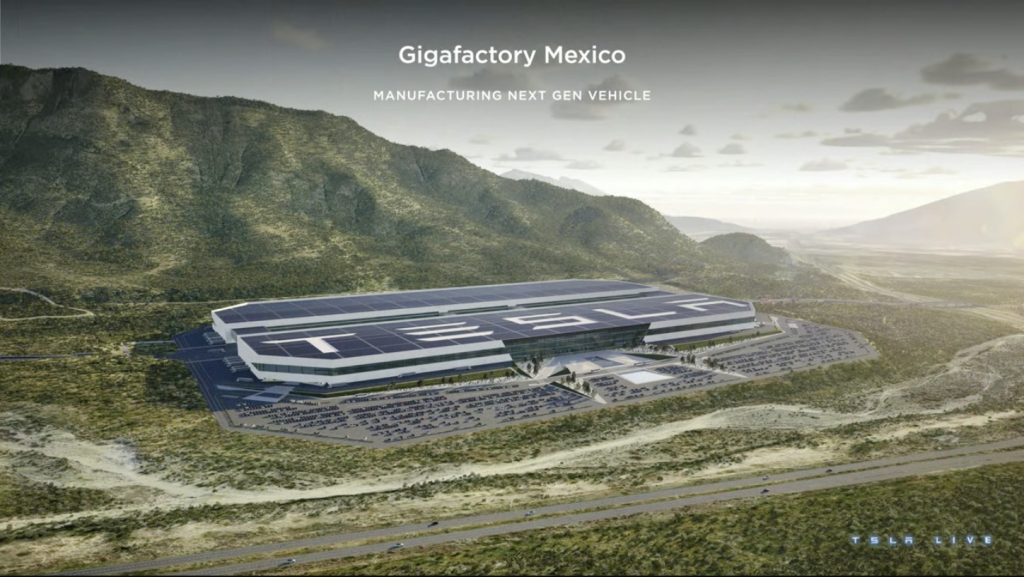
18:21 CST – The break ended up taking nine minutes. But the team is back, and Elon comes out and shows a render of Giga Mexico. Musk notes, however, that the capacity of Tesla’s existing factories will be ramped. Giga Mexico will be built in Monterrey.
18:10 CST – Five-minute break! After this, a Q&A session.
18:04 CST – Kirkhorn discusses Tesla’s improvement in interior process efficiency. He noted that ultimately, Tesla’s vertically integrated software that helps run the company. Kirkhorn is also confident in Tesla’s ability to generate the income needed to make investments to achieve Master Plan Part 3’s goals.
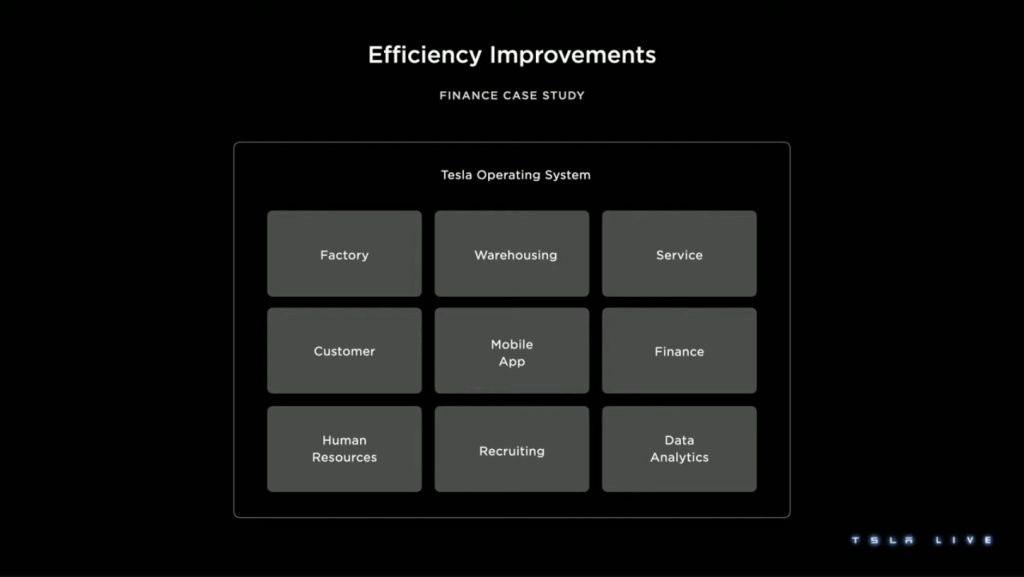
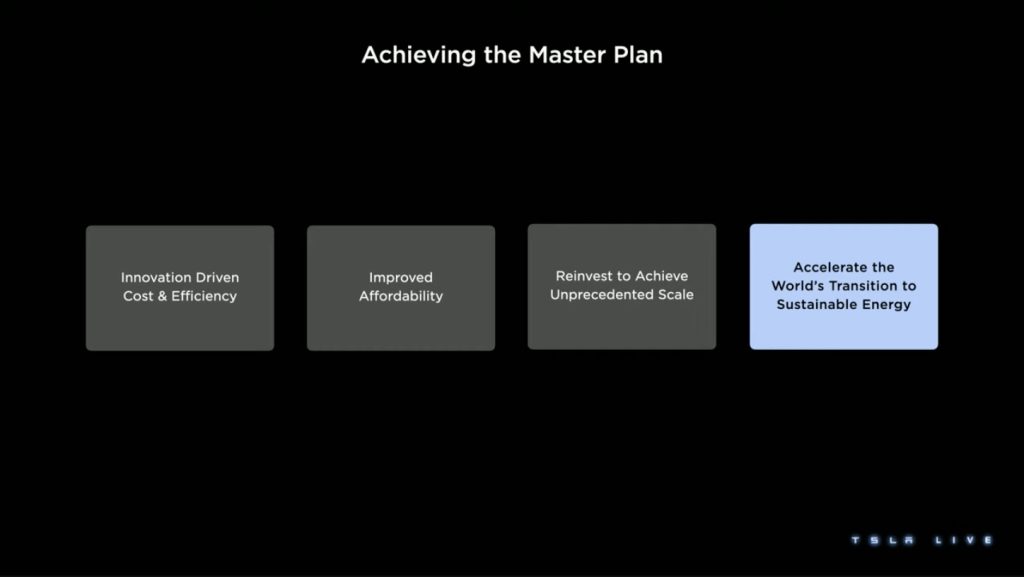
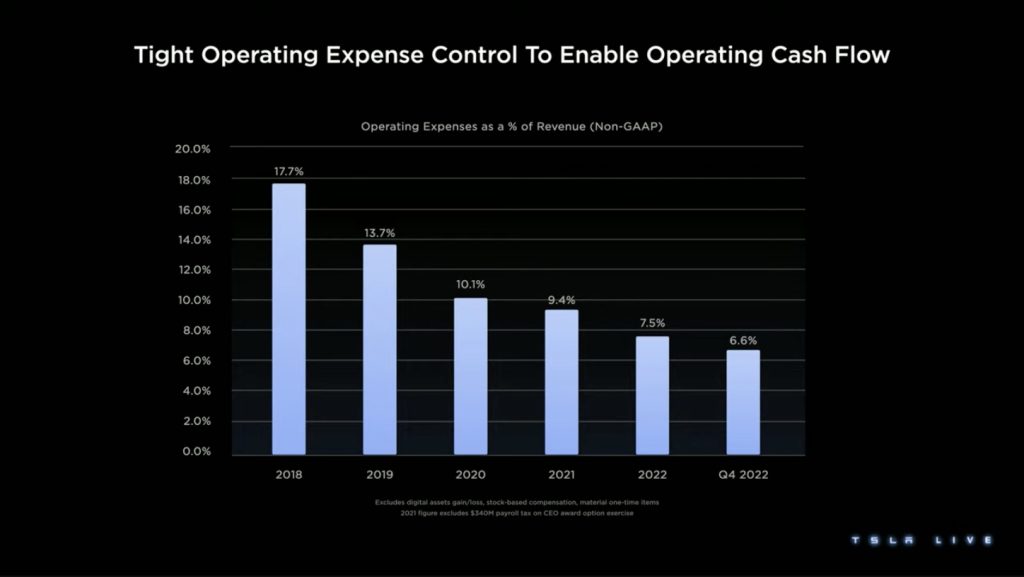
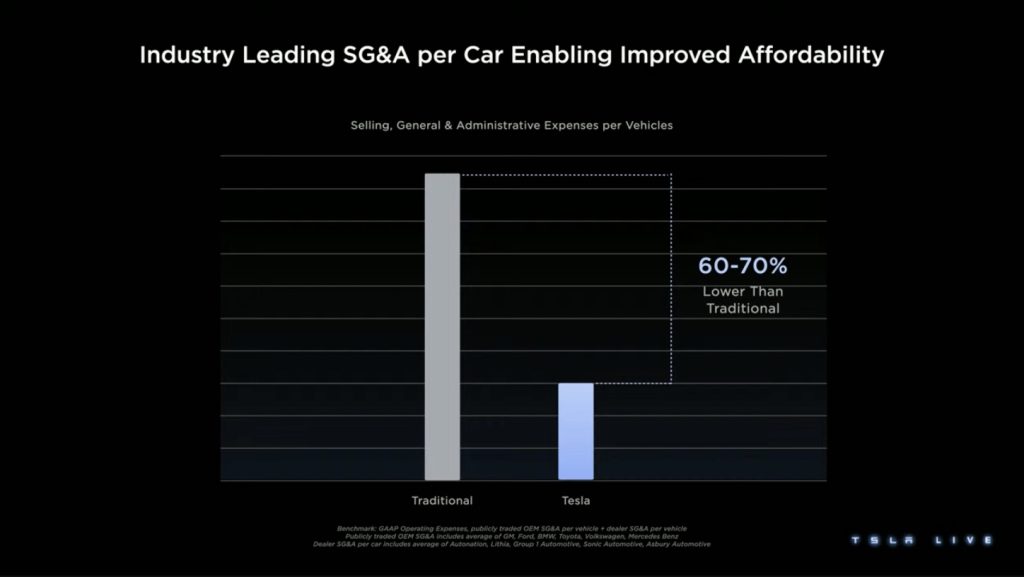
18:01 CST – Kirkhorn highlights Tesla’s Open and SG&A.
17:59 CST – Kirkhorn highlights that the next-gen platform is expected to enable a 50% reduction in costs. This means that the total cost of ownership of the next-generation platform would also be lower than the company’s current vehicles today. This is a big deal since the Model 3 is already cheaper to own than Toyota Corolla today.
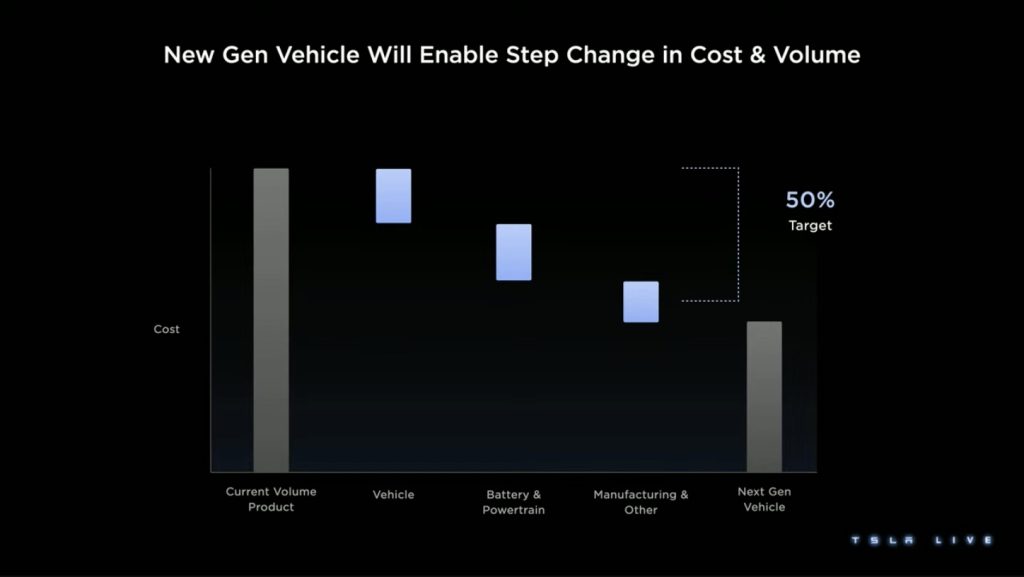
17:56 CST – Kirkhorn notes that cost reductions come from everywhere. He states that Tesla reduced the cost of the Model 3 by 30% since 2018 as of 2022.
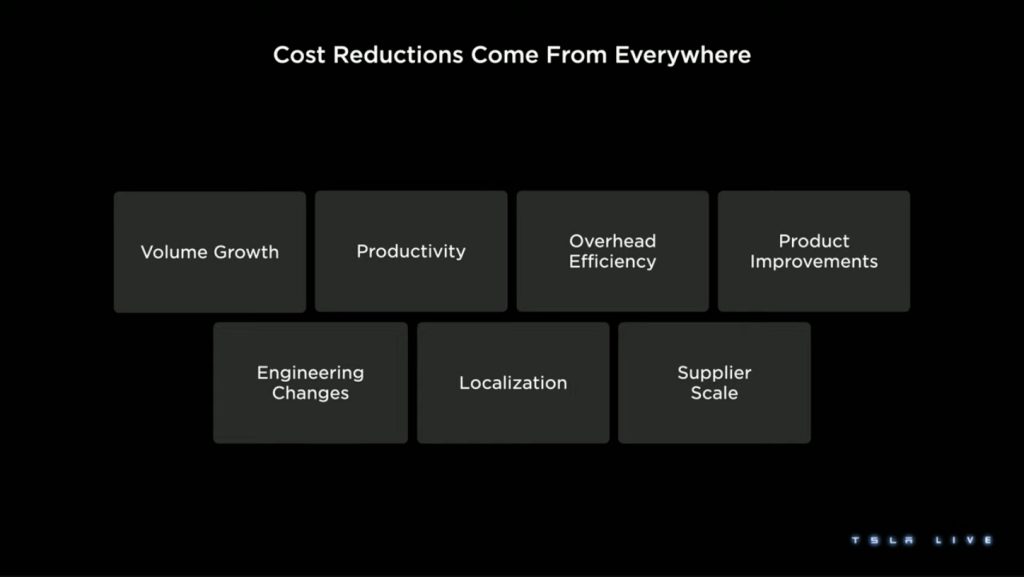
17:54 CST – Zach Kirkhorn returns to the stage. This will be the final part of the Investor Day presentation. He notes that this is the first time that Tesla brought out its specific leaders to discuss their work. He thanks the Tesla team as well.
17:51 CST – Laurie Shelby takes the stage to talk about the sustainability for Tesla for employees. Tesla seems to be taking a pretty cautious strategy here. The company wants to emphasize how the company values its team. She thanks the global Tesla team. She also noted that Tesla is aligning with the TSFD to release better reports to investors.
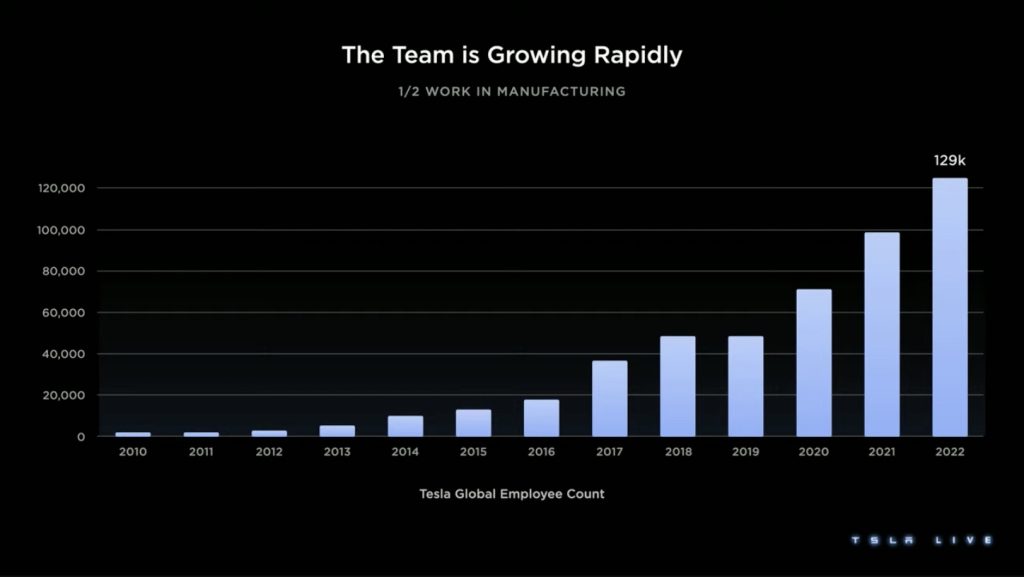
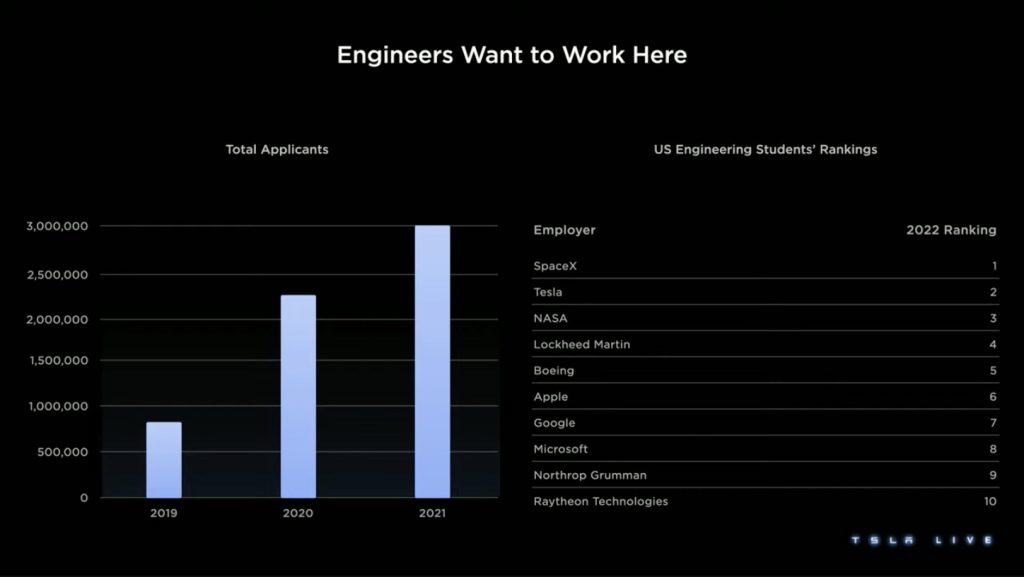
She notes that Tesla now has 129k employees. Almost 60% are based in the US.
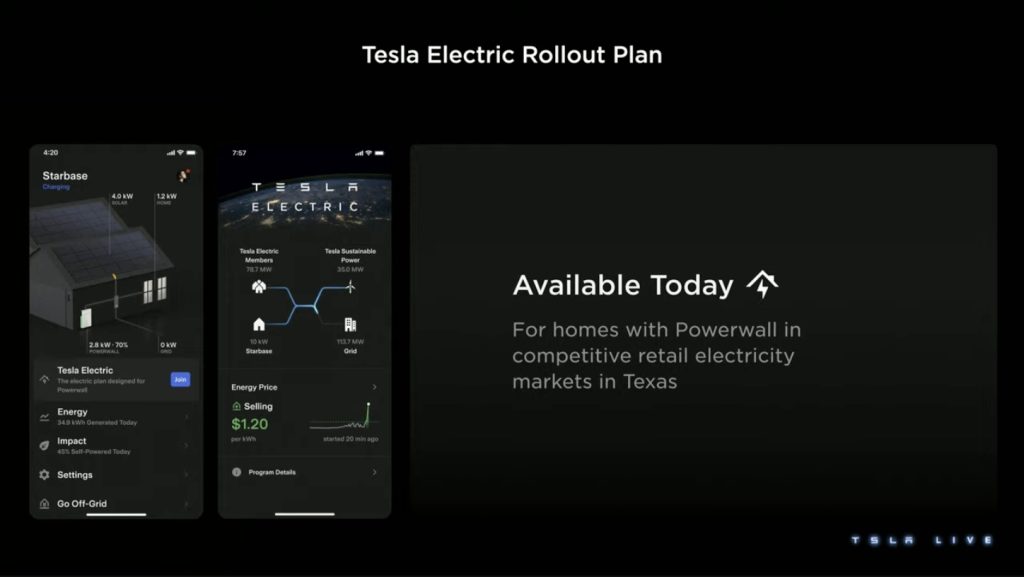
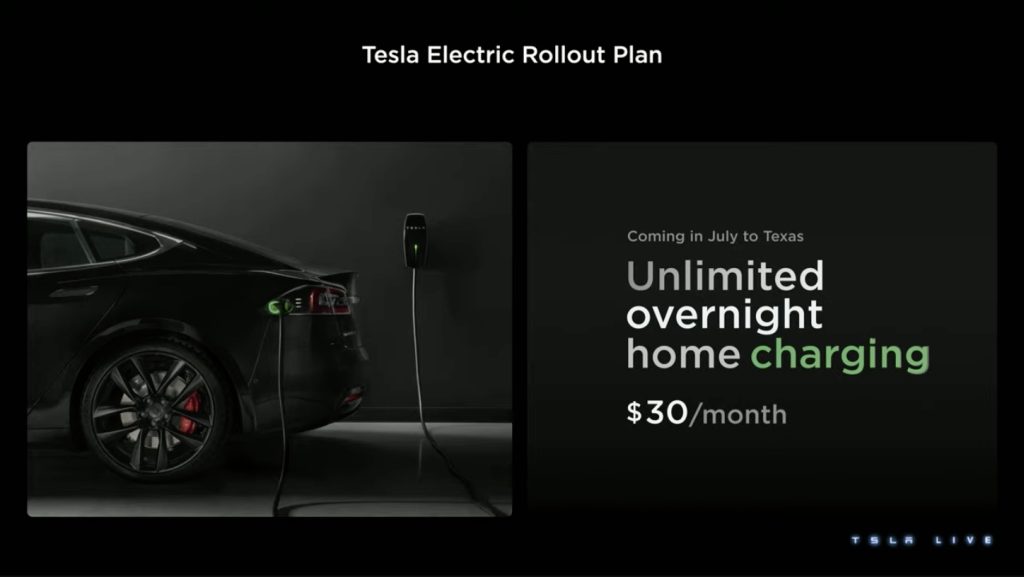
17:47 CST – Tesla Electric is rolling out in Texas too! The company plans to bring Tesla Electric market by market like Tesla Insurance. The service’s rollout in Texas will include $30 charging at night for customers who sign up for Tesla Electric.
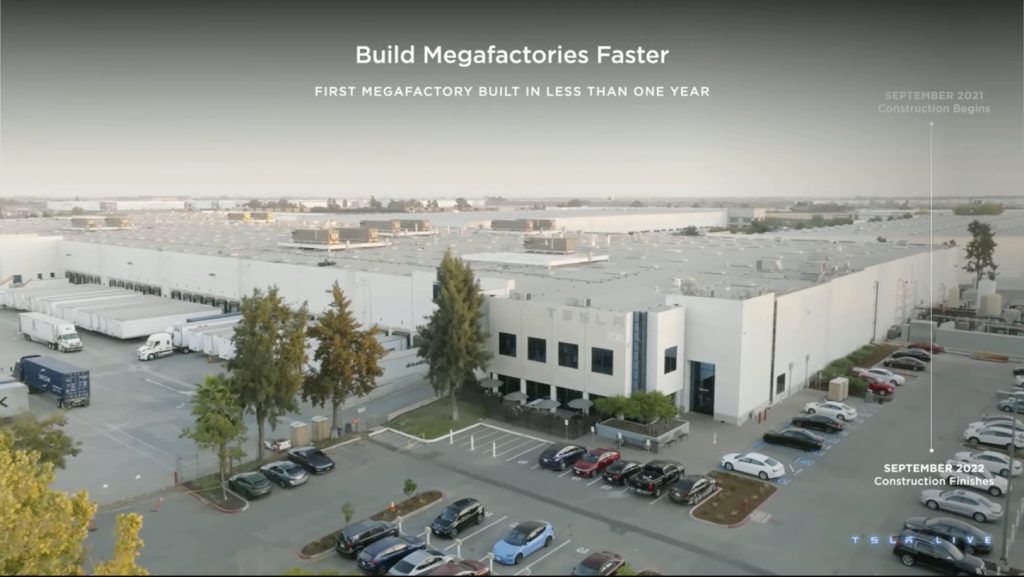
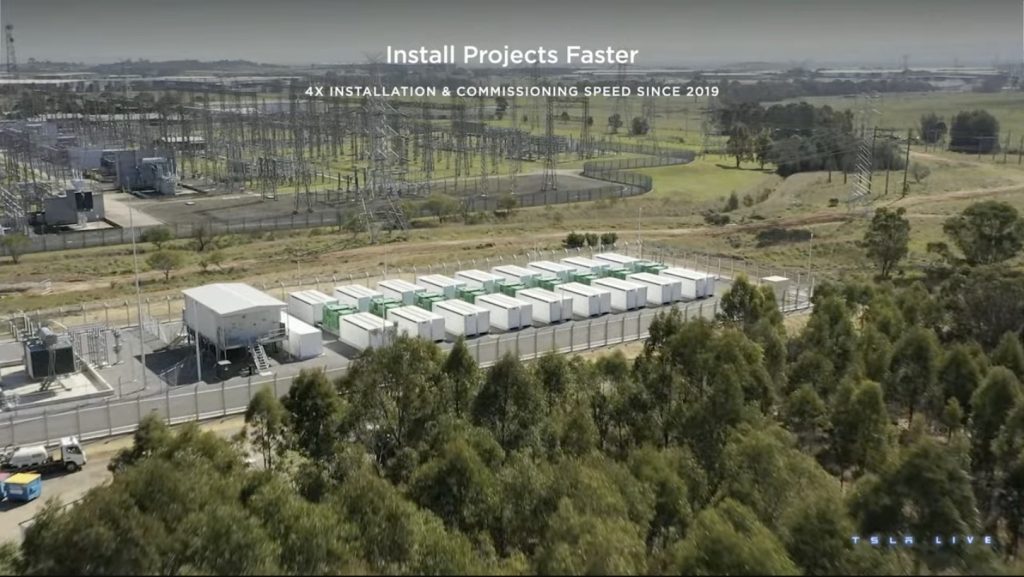
17:45 CST – The Megafactory in Lathrop may not be as high profile as the company’s Gigafactories, but it was built in less than a year. That’s pretty incredible. Project installations are also getting faster, with the company achieving 4X installation and commissioning speed since 2019.
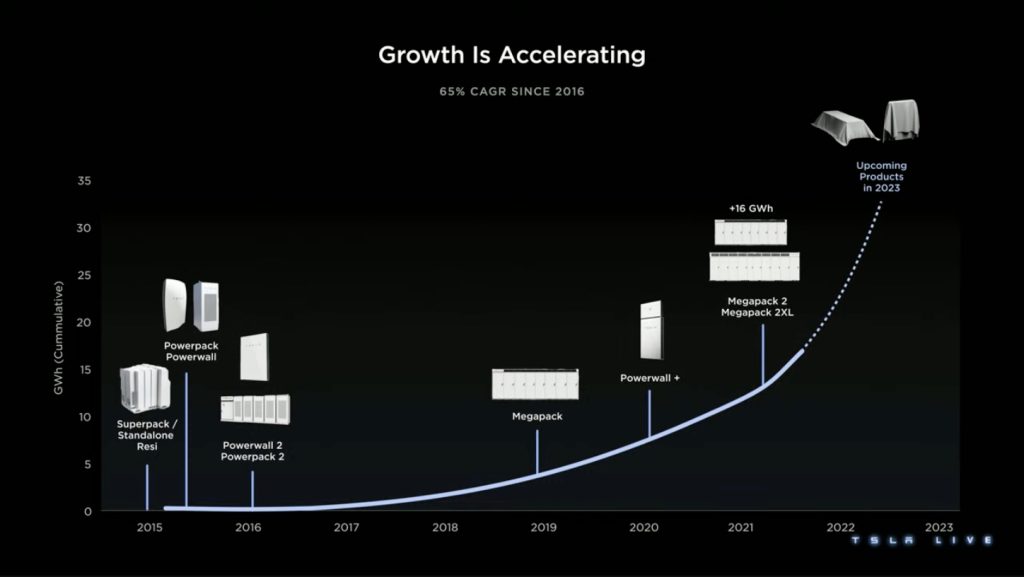
17:37 CST – Mike Snyder joins Drew Baglino the stage to talk Tesla’s Megapack. He noted that Tesla is now on its sixth generation of energy products, the Megapack XL and the Megapack 2. There’s been a lot of demand for the Megapack, and the Lathrop plant is ramping. This was only made possible by a maniacal focus and effort.
“This is the product that retires fossil fuels. One power plant at a time,” Baglino said.
17:33 CST – A photo of Tesla’s 50 GWh/year Corpus Christi Lithium Refinery was shared. The facility starts commissioning at the end of 2023.
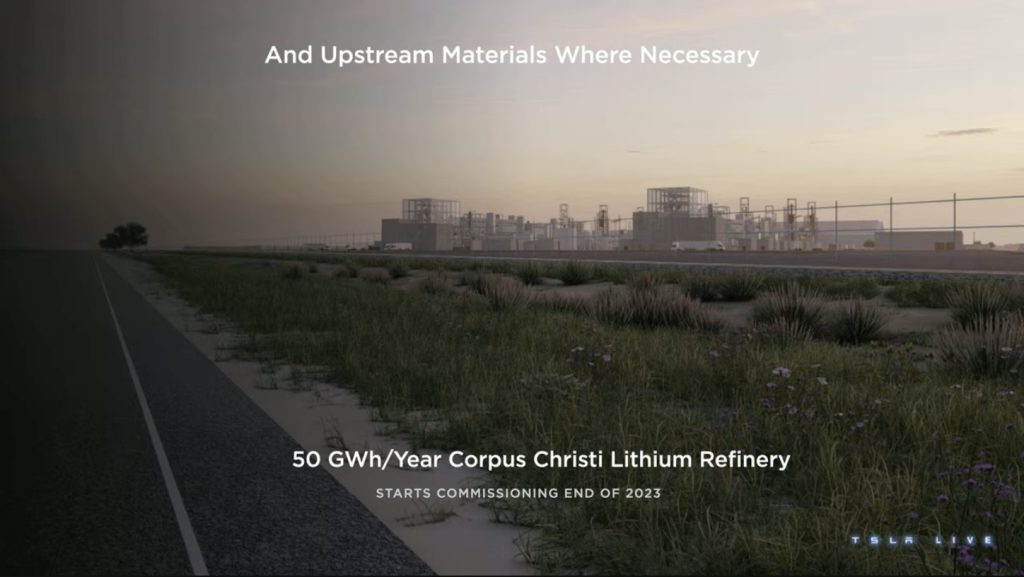
17:32 CST – Drew Baglino provides a quick update on Tesla’s battery program. No more spoons! There’s over 20x productivity from the tools the company showed during Battery Day at the pilot line in Kato Road. He also showed how Tesla’s battery factories are getting more and more efficient and simple, so they’re only getting better.
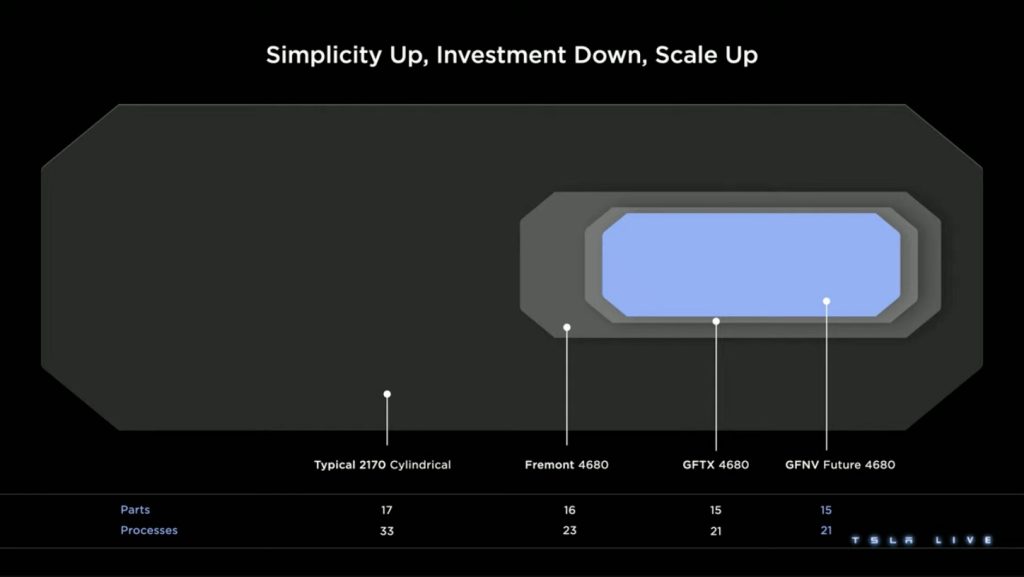
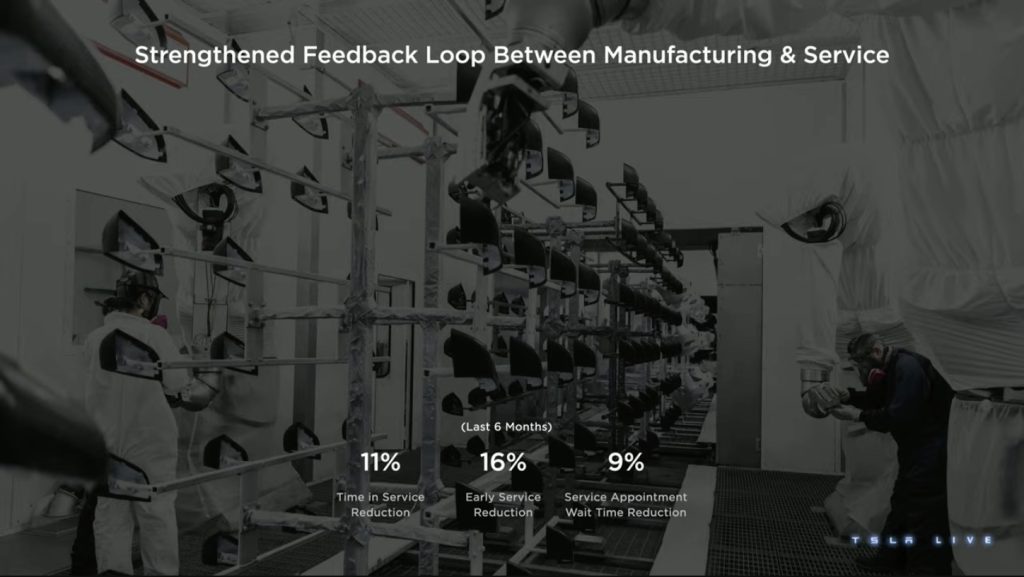
17:29 CST – Tom shares some states on Tesla service.
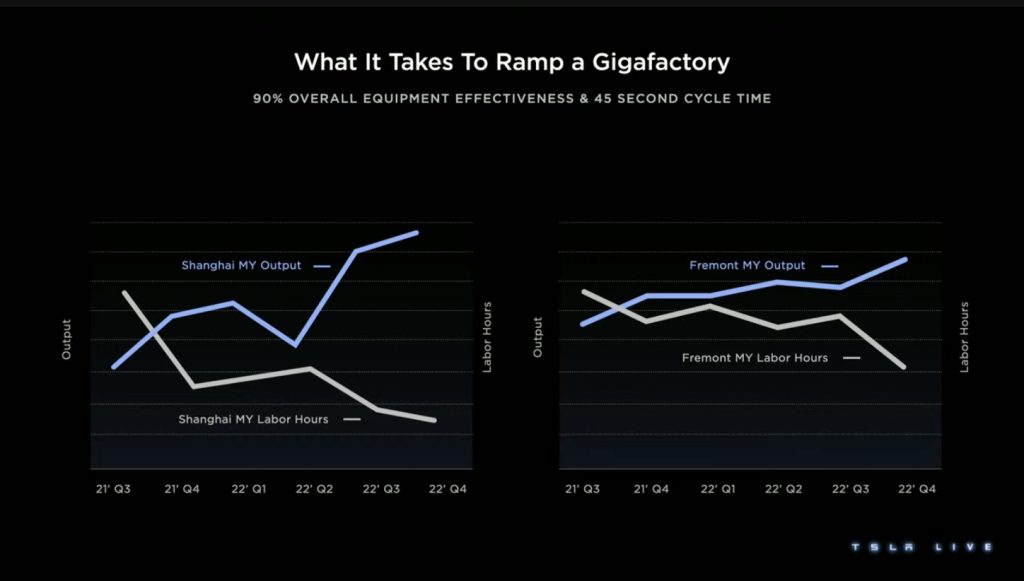
17:27 CST – Tom notes that ramping a Gigafactory is all about overall equipment effectiveness and cycle time. Fremont is a rockstar here, since it’s an older factory. But despite this, it’s getting better. Tom notes that Fremont just reached a new daily record recently.
17:26 CST – Tom notes that ramping a Gigafactory is all about overall equipment effectiveness and cycle time.
17:25 CST – Tom highlights that Tesla can build its factories extremely quickly. He noted that this is accomplished through many optimizations, such as an in-house team that constructs factories. He noted that the team behind Giga Shanghai was also the same one that did Giga Berlin.
Tom Zhu also confirms that Tesla has reached the 4 million vehicle mark. The vehicle was made in Giga Texas. The last 1 million cars were made in less than 7 months.
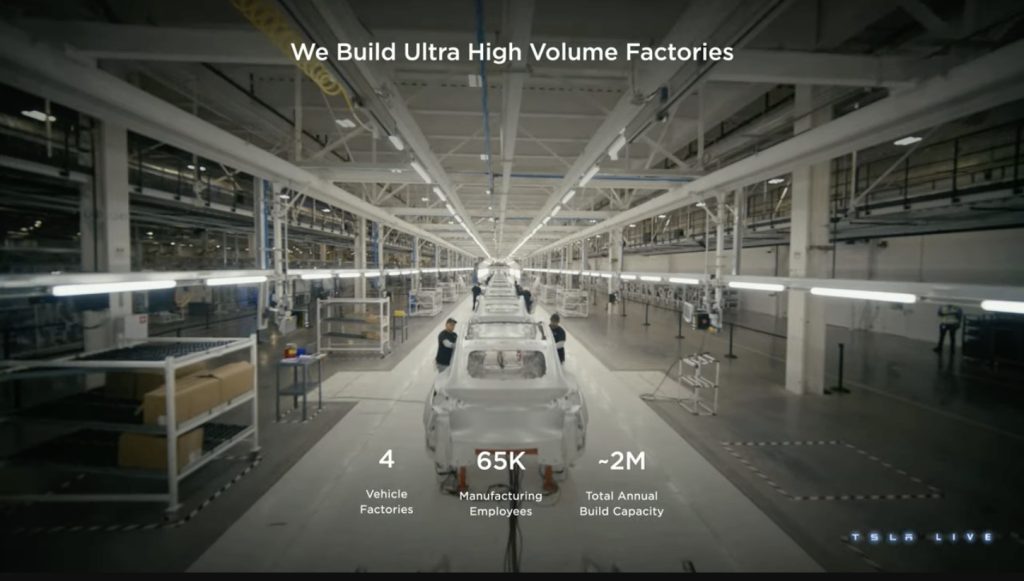
17:22 CST – Tom Zhu and Drew Baglino take the stage. They will be discussing how Tesla would make more cars, and how much faster the company could do it. Tom notes that Tesla currently have 65,000 manufacturing employees. Tesla’s factories are also ultra high-volume.
17:19 CST – The Tesla execs noted that the company’s Heat Pump assembly highlighted supply chain issues. Tesla solved heat pump assembly issues through automation.
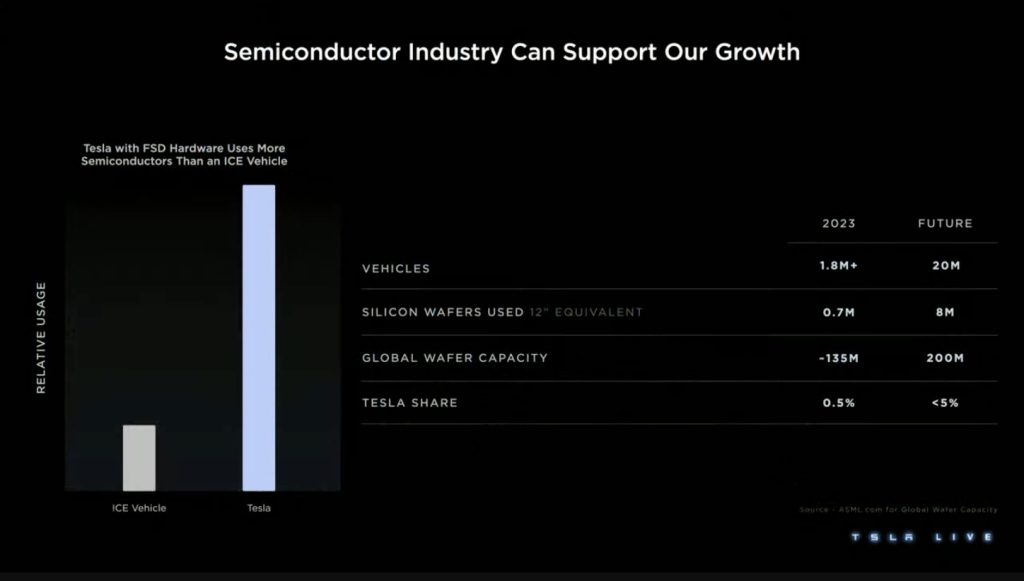
17:16 CST – The Tesla execs noted that Tesla will not break the semiconductor industry if it grows to 20 million vehicles. The semiconductor industry can support the electric vehicle maker’s growth, even if Tesla slows down — which would likely not happen.
17:14 CST – Tesla is also working with suppliers closer to their factories to decrease transportation time and reduce diesel use throughout the supply chain. This also decreases full productions stall times.
17:10 CST – The Tesla executives discuss the challenges that the company and its suppliers faced during the Covid pandemic. The ordeal was tough, though the company and its suppliers powered through to deliver.
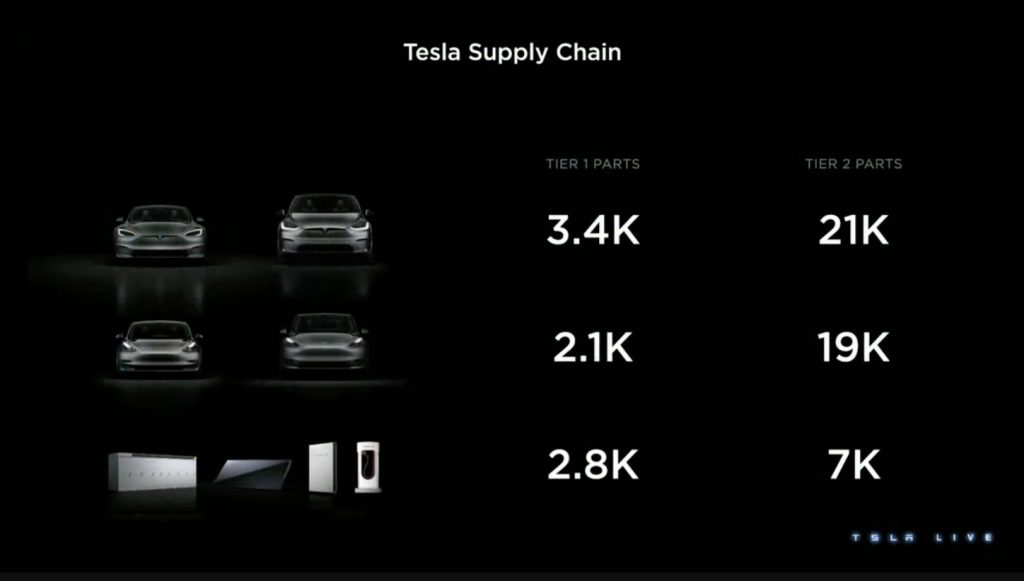
17:04 CST – Tesla executives Karn Budhiraj and a colleague discuss the company’s supply chain. They provide an overview of Tesla’s current supplier setup.
17:01 CST – Overall, while Tesla has already been building Superchargers for the last ten years, the company is still just starting. Tesla Supercharger V4 is being installed in Europe, and it will be optmized for charging all electric cars, not just Teslas. Amidst all this, Tesla will never forget to do some cool things in the process.
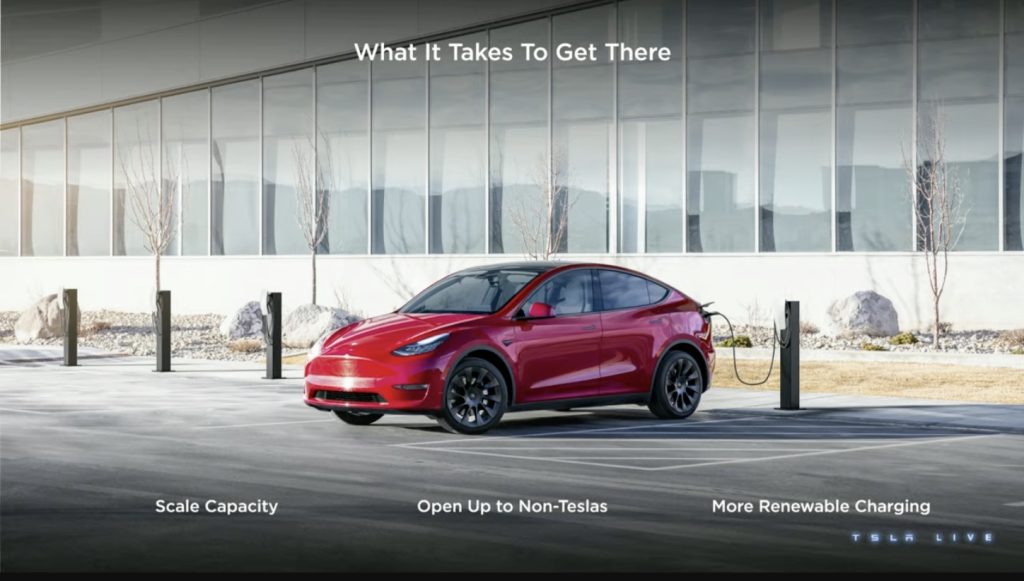
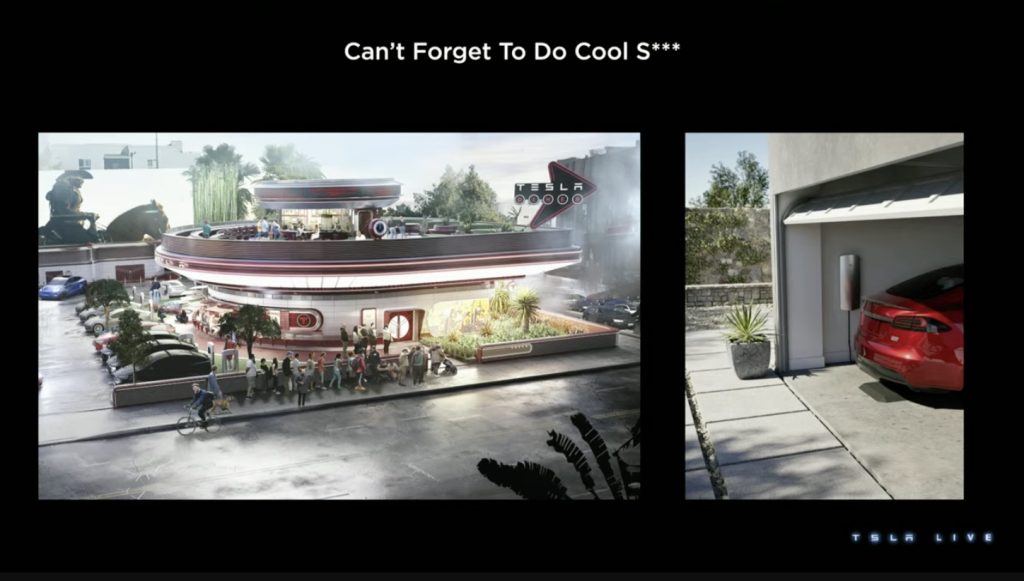
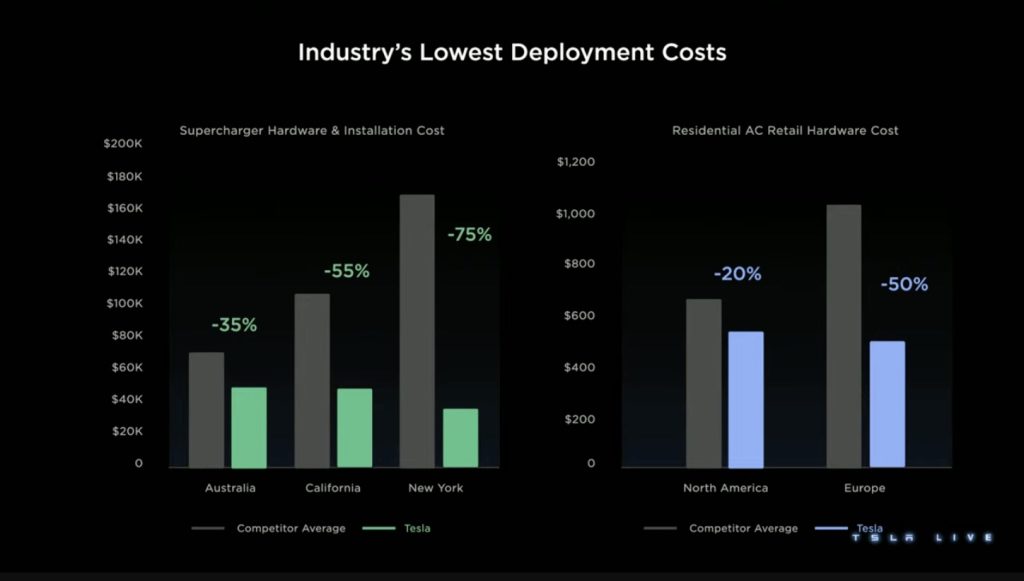
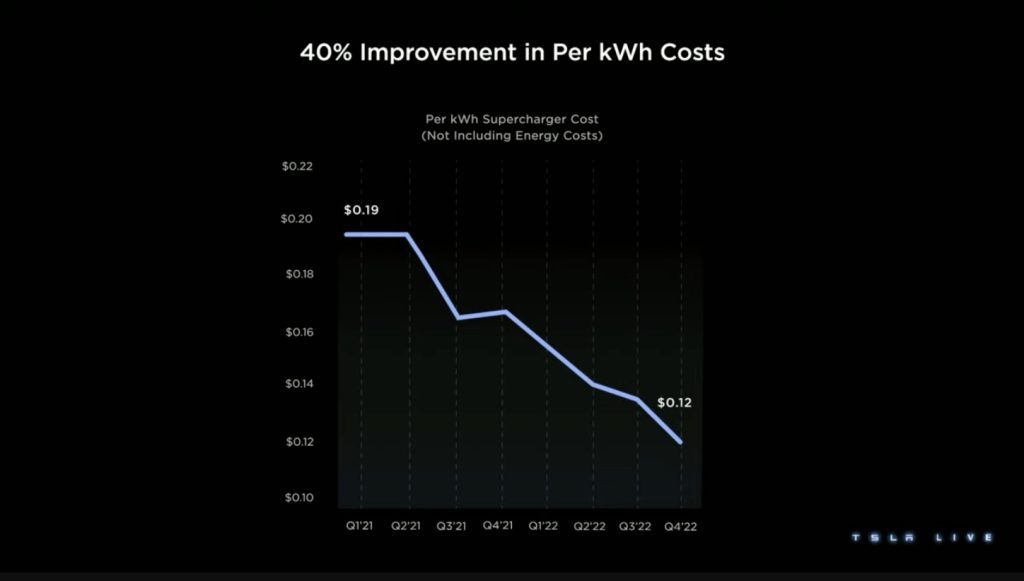
16:54 CST – Rebecca Tinucci takes the stage to discuss Tesla’s Superchargers. She highlighted that Tesla has spent the last ten years establishing its Supercharger Network across the world. Thanks to this experience, Tesla Superchargers have the lowest deployment costs. She notes that prefabricated four-post Superchargers are being produced at Giga New York. She also hinted that Tesla plans to improve Trip Planner by projecting potential customers that might use nearby charging stations.
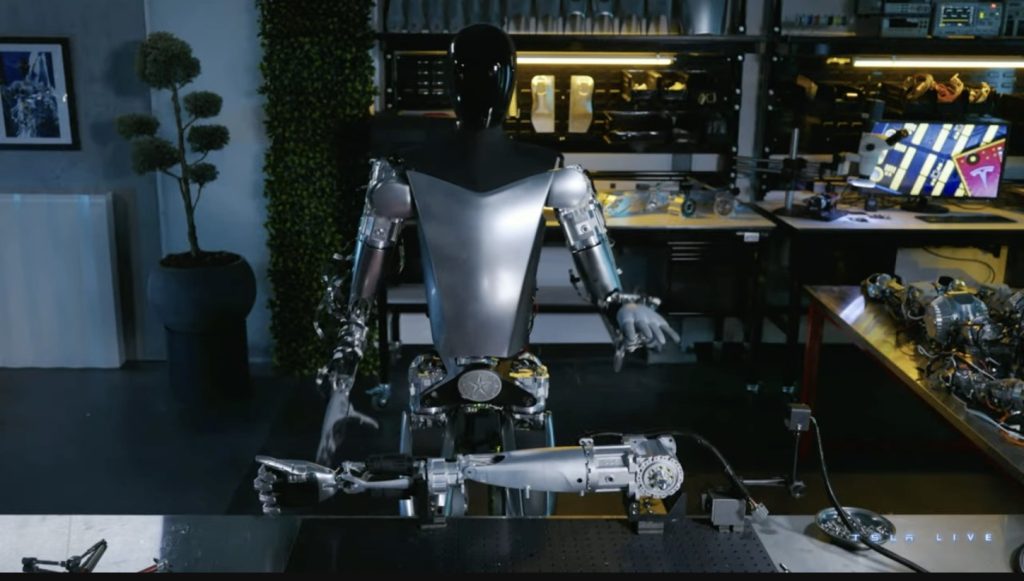
16:51 CST – Elon notes that Optimus utilizes Tesla’s expertise in manufacturing. Actuators, battery packs, and Optimus’ other key components are custom designed by Tesla. Elon also noted that Tesla was shocked that not a lot of parts to make a humanoid robot can be bought “off the shelf.” The CEO is also confident that Tesla can bring a working, useful humanoid robot to scale faster.
16:48 CST – Elon returns to the stage for some more updates. A video of Optimus is shown. The humanoid robot seems more refined compared to its iteration during AI Day 2022. The robot is now walking, and working on another robot. Multiple Optimus prototypes are also working.
16:42 CST – Ashok highlights that Tesla’s approach to AI systems is quite different from before. This allows the company to solve complex planning problems using artificial intelligence, among others. He also noted that manual labeling is insufficient, so Tesla is adopting an automated labeling system. Also, Dojo will perform better than current “compute” capabilities at Tesla.
16:38 CST – Ashok Elluswamy takes the stage to discuss Full Self-Driving. he notes that self-driving is actually a critical part of a sustainable future. He noted reiterated Elon Musk’s points in Master Plan Part 2, where unused cars could be used by other commuters.
16:34 CST – Pete Bannon and David Lau noted that during the days of the Model S, it did not take long before it because evident that it was easy to misassemble the car. These were adjusted in later vehicles. Today, mistakes in assembly are caught while the vehicle is being produced.
16:32 CST – Pete Bannon and David Lau discussed how Tesla’s software and connected cars enable the company to roll out improvements at speed. This is especially useful for vehicles’ safety, which Tesla excels in. The Model S and Model X’s predictive air suspension system is a good example of this.
16:26 CST – Pete Bannon and David Lau show the path toward the next-generation platform.
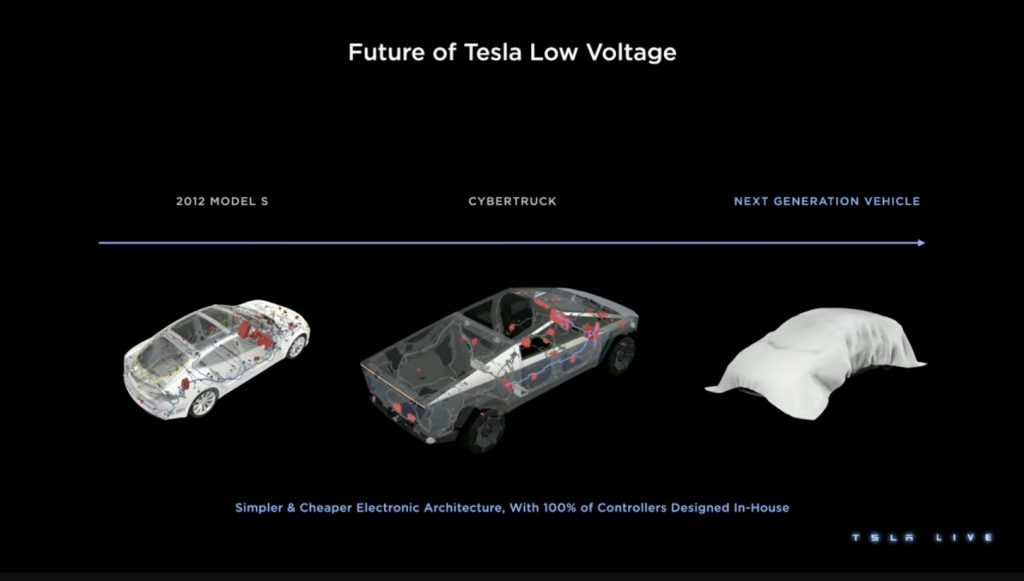
16:23 CST – Pete Bannon and David Lau discuss more optimizations that have been done over the years. These include the shift e-fuses, as well as the replacement of lead acid batteries to lithium-ion. Costs are coming down too, such as in components like the Model 3’s center display, which has gotten cheaper over time.
Cybertruck, Optimus, and future vehicles will also use 48-volt architecture. Cybertruck is also designed with a local controller for better wire pathways.
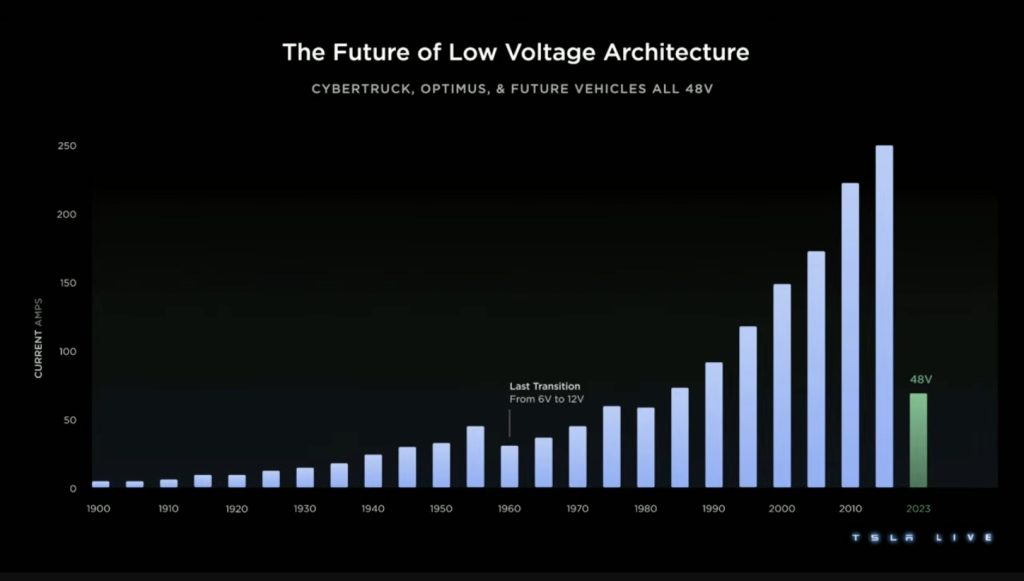
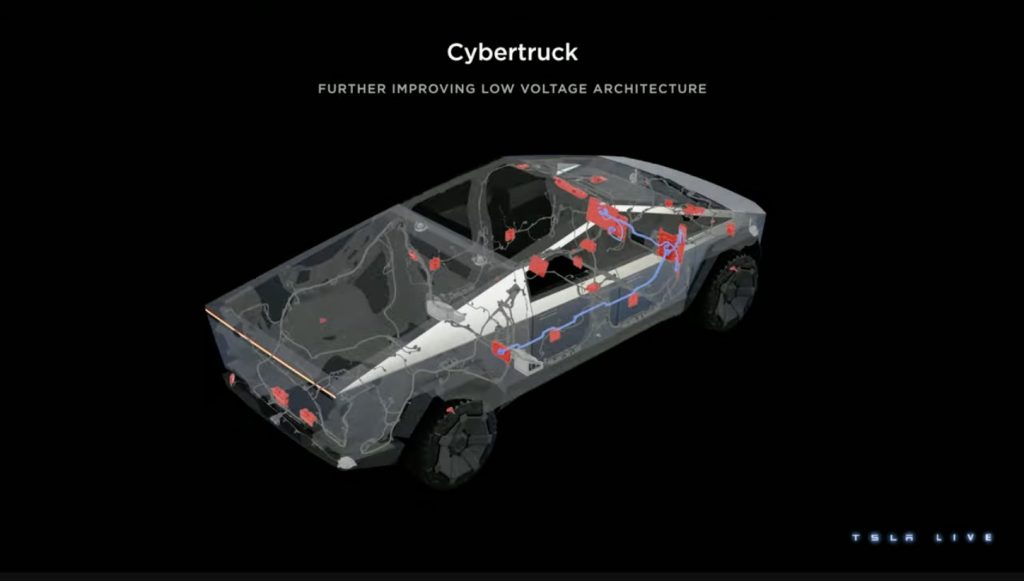
16:23 CST – Pete Bannon and David Lau discuss more optimizations that have been done over the years. These include the shift e-fuses, as well as the replacement of lead acid batteries to lithium-ion. Costs are coming down too, such as in components like the Model 3’s center display, which has gotten cheaper over time.
16:20 CST – Pete Bannon and David Lau take the stage. Pete Bannon highlighted that low-voltage electronics in vehicles have been messy so far. The executives noted that from Model S to Model 3, Tesla was able to reduce its wire harnesses by 17 kilograms. Shared controllers also helped simplify the supply chain.
For Cybertruck, Tesla is designing 85% of the controllers in the car. In the next-gen platform, Tesla is designing 100% of the controllers.
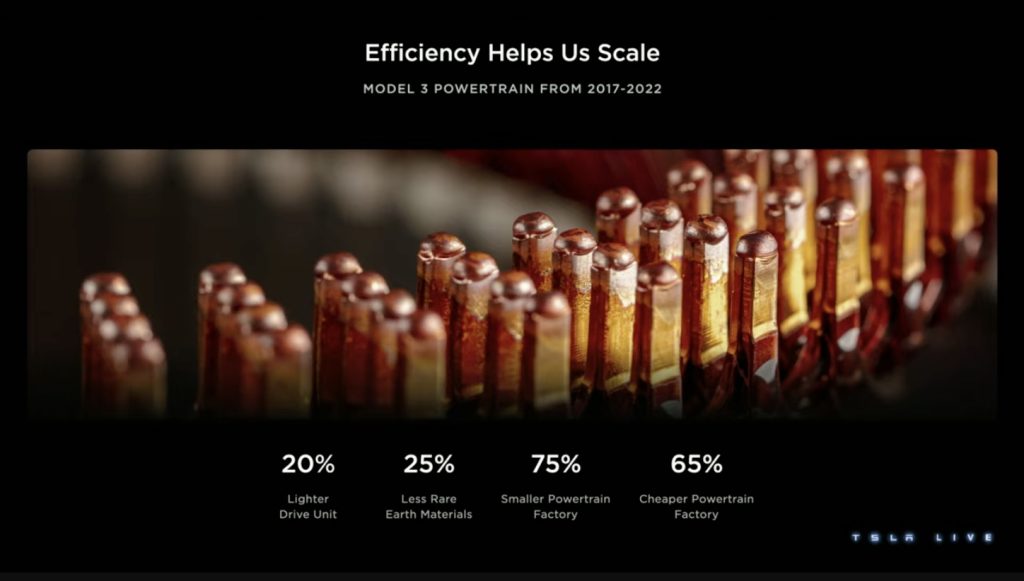
16:17 CST – Colin noted that Tesla’s next-gen vehicle will not use rare earth materials at all. They will be built in compact and high-efficiency factories. The executive stated that these are only possible because of the hard work of the Tesla team.
16:15 CST – Colin also discusses the importance of Tesla’s power electronics and software. He also highlighted that Tesla excels in manufacturing line and automation design. This enables Tesla to design products that are both high-performance and easy to assemble.
Tesla’s next-generation platform will have 75% less silicon carbide. Any battery chemistry will be accepted as well. The vehicle will feature a 50% reduction in factory footprint.
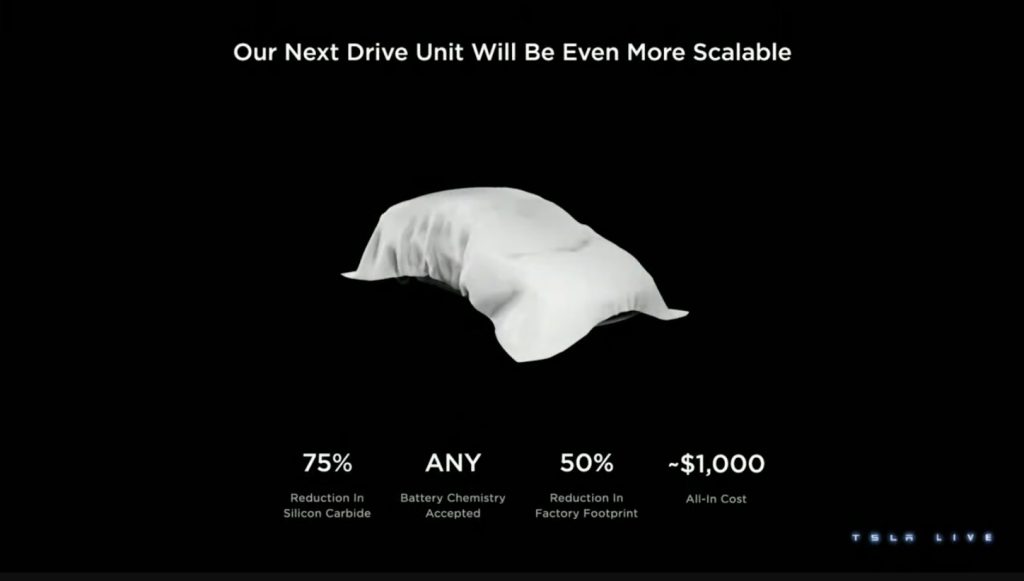
16:11 CST – Colin Campbell, leader of powertrain engineering, takes the stage. He noted that Tesla is known for speed. He highlighted that Tesla is all about efficiency. He noted that Tesla is able to achieve its efficiencies by moving as one company. Changes can then be made to both vehicles and factories. Everyone works together.
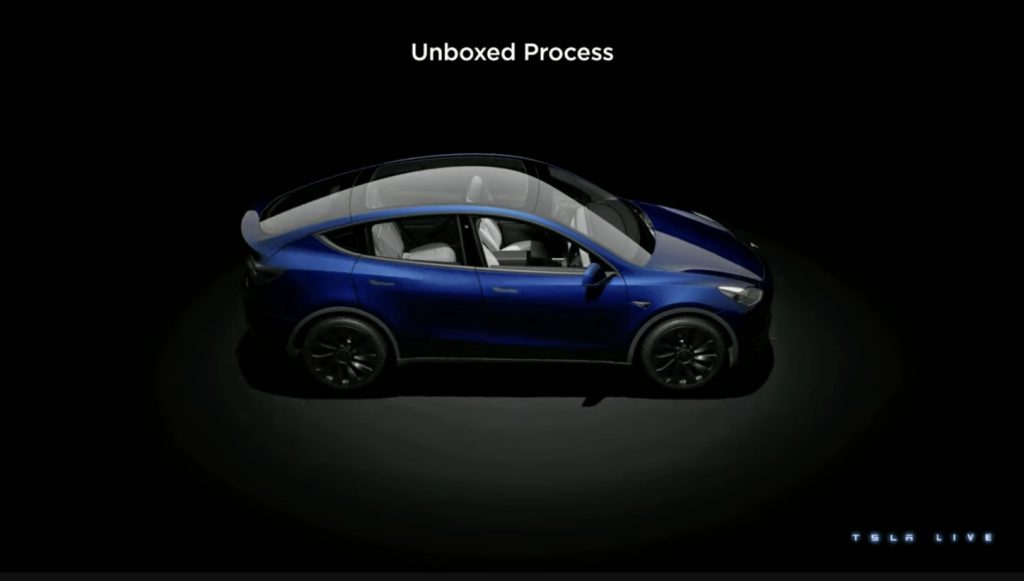
16:07 CST – Franz and Lars noted that in the next-generation vehicle, more people (or robots) should be able to work simultaneously. Lars noted that this gives more operational density. More space time efficiency. This makes automation a lot easier. Tesla lists this as an “unboxed process.”
Franz and Lars noted that Tesla’s next-gen manufacturing would reduce 50% of costs.
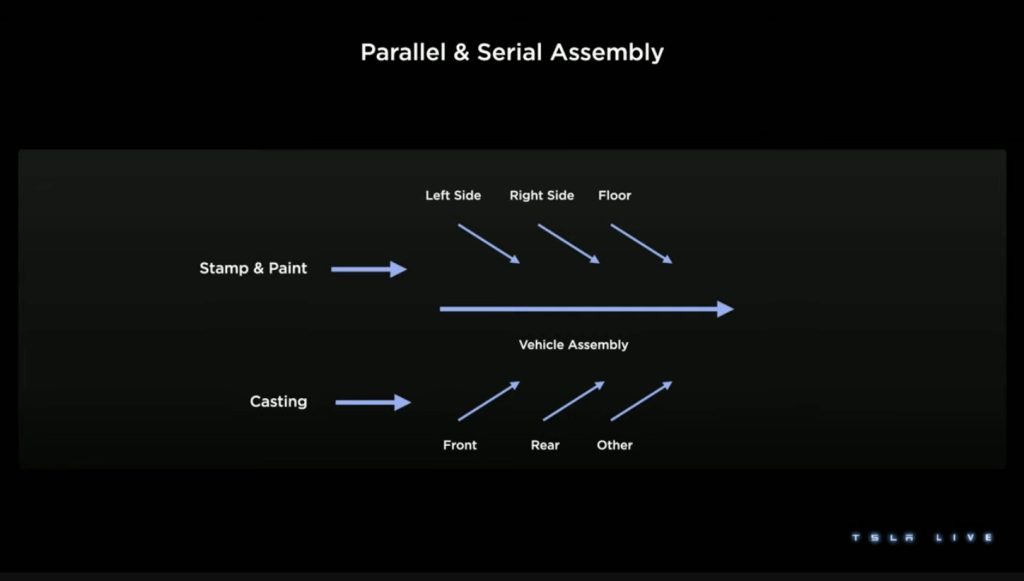
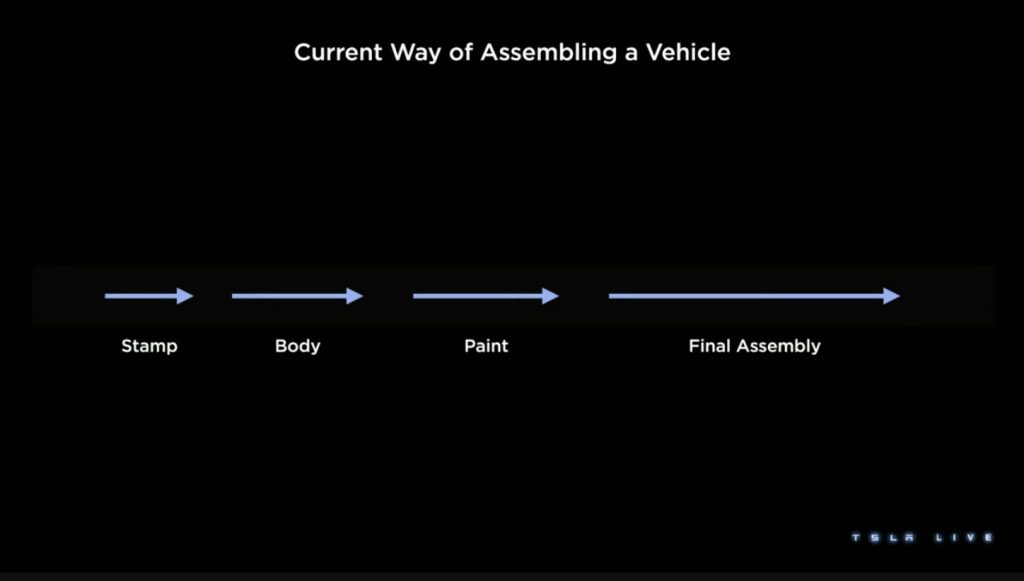
16:04 CST – Franz and Lars discuss the traditional way to assemble a vehicle, from stamping, body, paint, and final assembly. Lars note that this is great, but delays in one line stops the entire thing. He stated that there are a lot of inefficiencies in the process. Lots of areas for improvement.
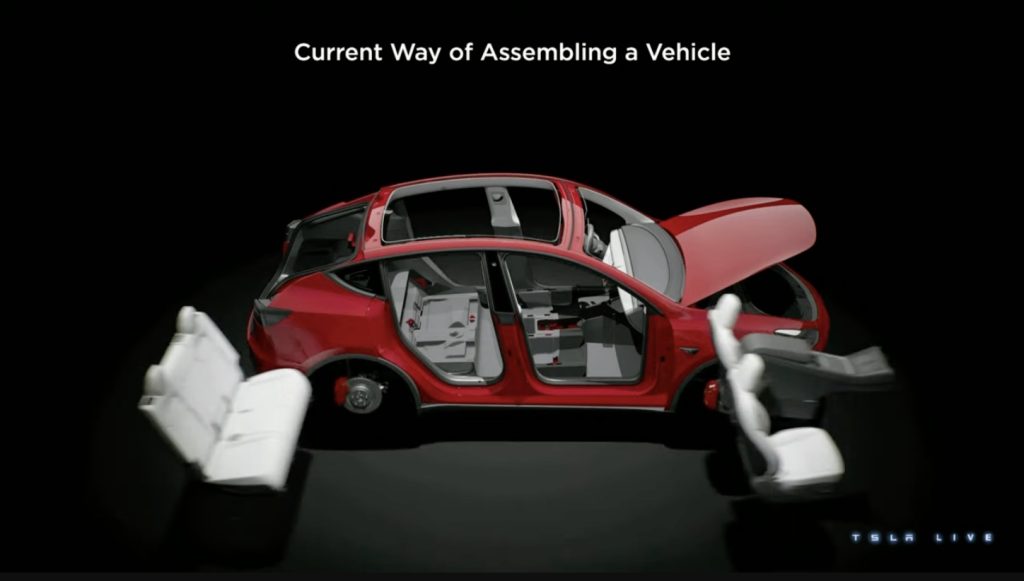
16:02 CST – Franz and Lars noted that Cybertruck is a completely different animal. It is then a vehicle that needs to be approached in a completely different manner. Cybertruck was designed with the manufacturing process in mind. Lars added that the Cybertruck actually makes its manufacturing footprint small, since it doesn’t need paint or stamping. Franz reconfirms Cybertruck is coming this year.
16:00 CST – Franz and Lars noted that as time went on, Tesla had to approach its vehicles more differently. This was the case with the Model 3. The executives discussed production hell, which involved Tesla looking to manufacture a product designed to be built manually being built on an automated line. There were lots of lessons learned there.
15:58 CST – Franz notes that during Tesla’s early days, it was a lot different. There were only a handful of people then, but Tesla was already dead set on making a difference. Franz noted that Tesla’s small teams before allowed the company to really focus on the nitty-gritty details of the car. The Model S is one of these, Franz and Lars said.
15:56 CST – Franz von Holzhausen and Lars Moravy take the stage for Part 2.
15:55 CST – Drew Baglino addresses the question of mineral use as the Earth shifts to a sustainable energy economy. Elon also reiterated his previous statements about lithium.He notes that the lithium in the United States is already very abundant. It’s the refining of lithium that’s a limiting factor today.
Elon also noted that nickel is needed for aircraft, boats, and long-range cars. The vast majority of transportation will need iron. And with recycling in the picture, the resources that the world will need to shift to sustainability will be even more efficient.
15:53 CST – The Tesla executives highlighting that transitioning to a sustainable economy will actually involve less fossil fuels compared to what’s currently being spent today. Here’s a nifty little graphic.
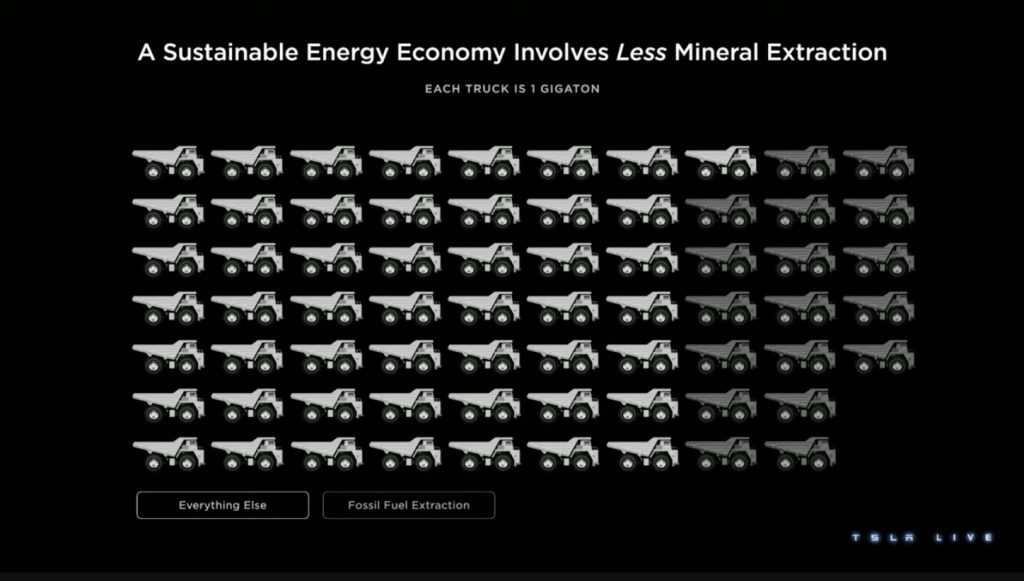
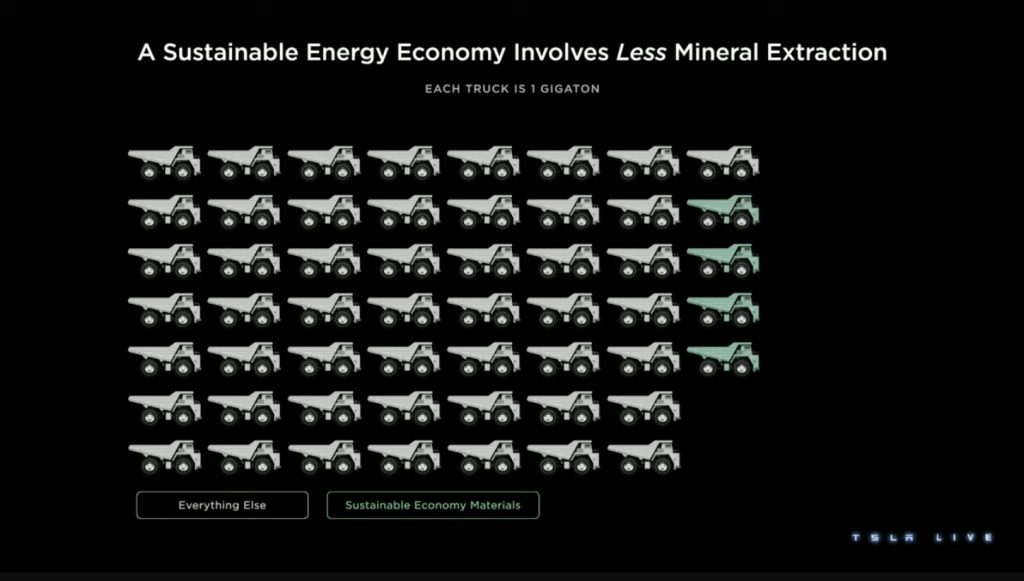
15:49 CST – Elon and Drew noted that these estimates for the investments needed to propel the world to sustainability are completely feasible.
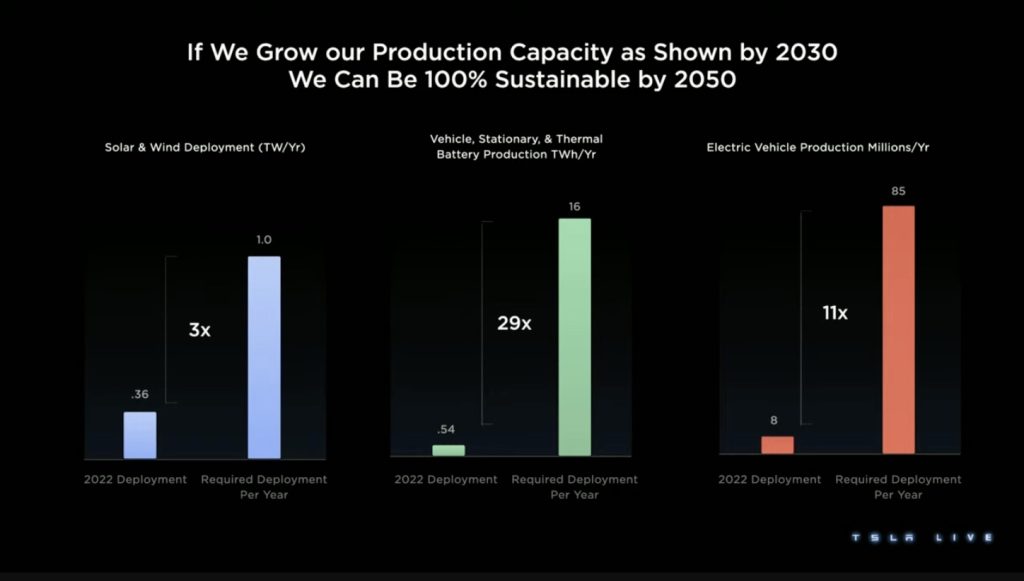
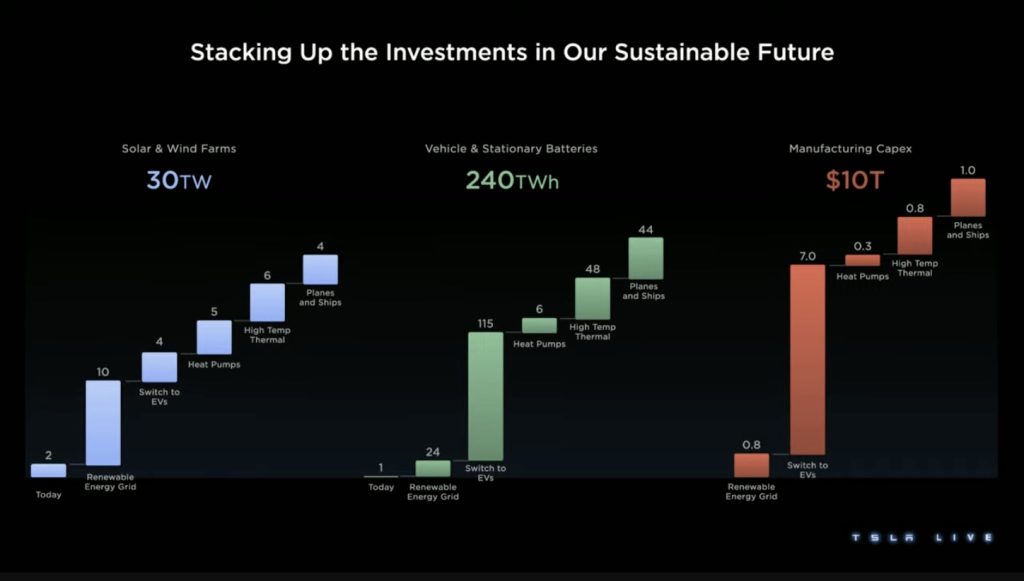
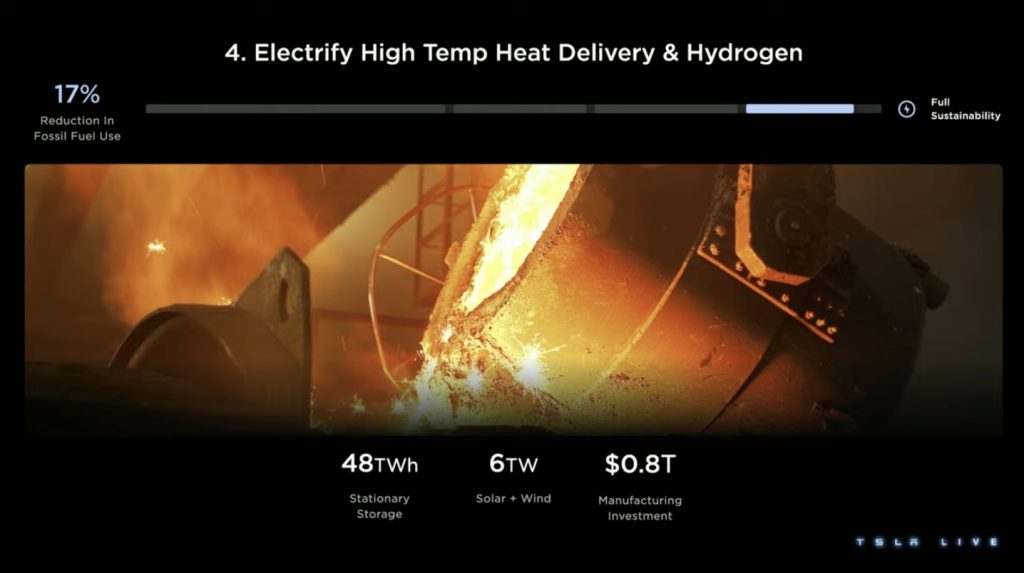
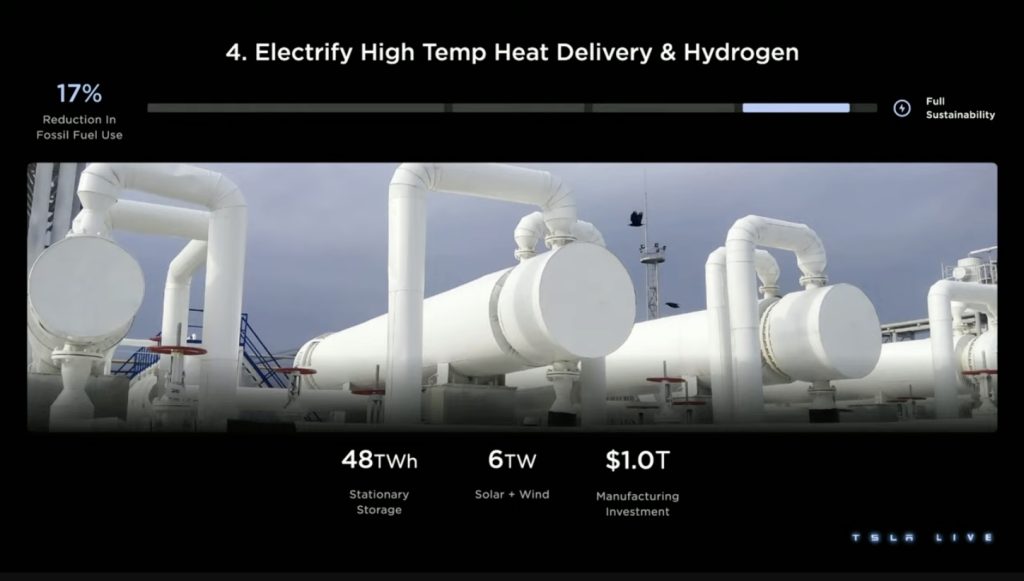
15:46 CST – Drew Baglino noted that heat pumps would go a long way toward making homes sustainable. From an industry perspective, heat pumps pave the way for efficiencies. He also discusses high temp heat delivery and hydrogen. Elon notes that hydrogen will be useful for industrial processes, but it is NOT something that should be used for cars. He also sheds light on the need to shift the shipping industry to sustainability.
15:43 CST – Tesla gives a quick overview of how Tesla could create a global electric vehicle fleet. The company shows an assumption for a fleet of about 85 million vehicles. That’s already substantial.
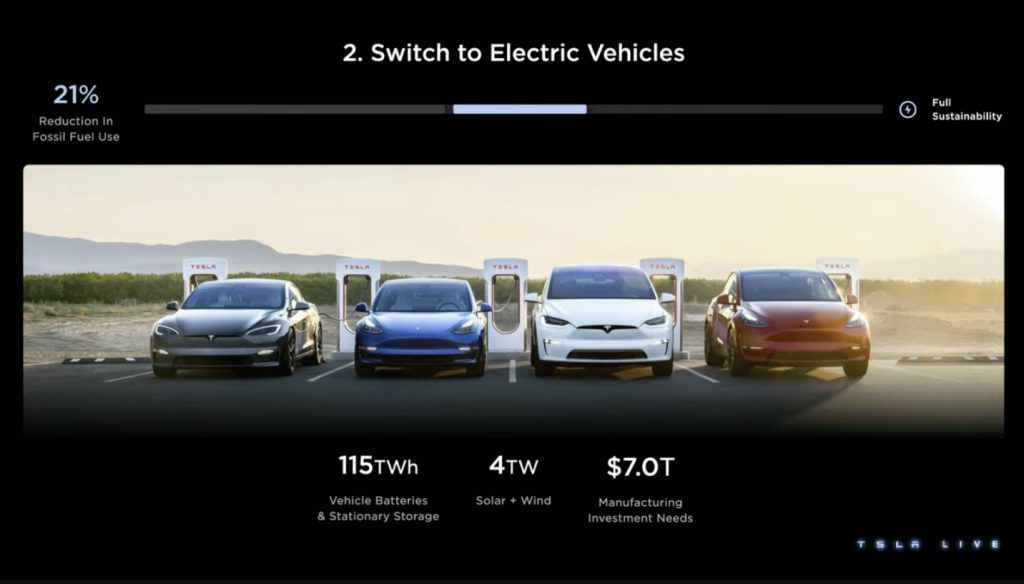
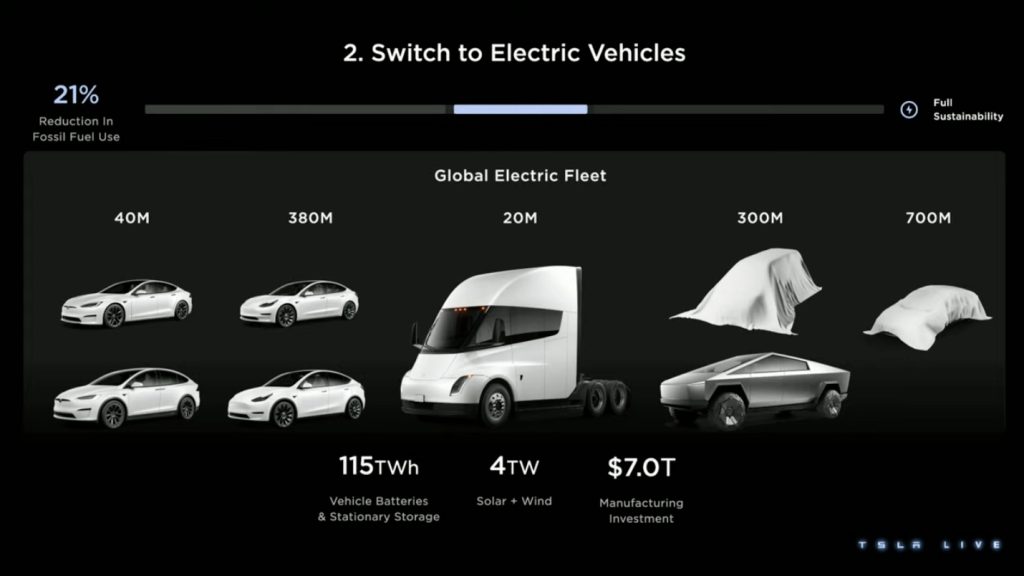
15:40 CST – Elon notes that all forms of transport will probably be electric. But not rockets, at least for now.
15:38 CST – Elon and Drew show a slide showing what’s needed to reach a sustainable economy. The executives noted that while these numbers may seem large, they actually are not if they’re compared to the global economy. Just about $10 Trillion investment to build sustainable energy economy.
“For a remarkably small land area, we can go fully sustainable,” Musk said. “The electrified economy will use less resources than the (fossil fuel) economy.”
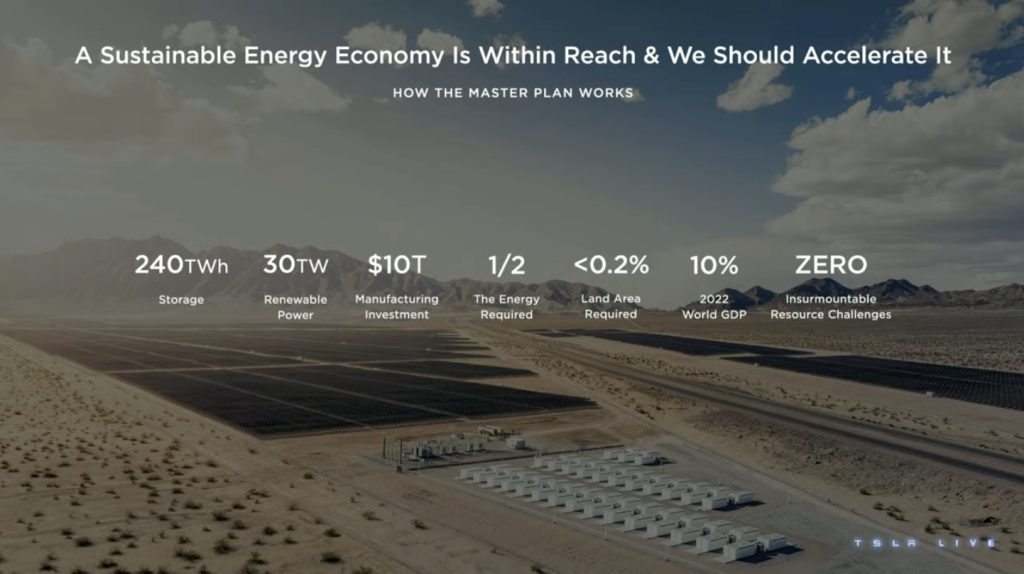
15:33 CST – Drew Baglino notes that today’s energy economy is dirty and wasteful, and that 80% of global energy comes from fossil fuels. Musk highlights that the use of fossil fuels actually waste a lot of energy. He also noted that calculations for a sustainable world typically assumes the same wastage as a world powered by fossil fuels. This, Elon Musk noted, is not accurate.
15:31 CST – Elon Musk notes that there is a path towards sustainability, where the Earth could support the 8 billion people today. “There is a clear path to a sustainable energy Earth with abundance,” Musk said.
15:30 CST – Elon Musk and Drew Baglino take the stage for the event’s first part. Elon jumps right into it. This is Master Plan Part 3. Here we go.
15:28 CST – And it’s starting! CFO Zach Kirkhorn is opening the event. Kirkhorn noted that today, Tesla is not just talking about the near future.
There will be three parts of the event. One, Tesla’s macro vision. Next, it will be focused on Tesla’s function. The third will bring everything back.
15:25 CST – Well, it seems like the stage is ready for the Investor Day keynote.
15:23 CST – Elon said the presentation starts in about 5 minutes — 8 minutes ago.
15:20 CST – Never change, Tesla. And never change, Elon.
15:19 CST – Check out these Model Y castings outside Giga Texas. Definitely highlighting this “extreme scale” theme Elon Musk referenced.
15:17 CST – What are you most excited for in Tesla’s 2023 Investor Day? Master Plan Part 3? More Cybertruck deets? The third-gen platform? Please sound off on our comments section below! I’m personally biased for the third-genp platform, but only because I’m a cheap guy by default.
15:14 CST – Well, Tesla is late, and the EV community has a great sense of humor. Who’s playing the 2023 Investor Day Bingo? I have a feeling the “wears trademark jacket” and “cracks joke” are getting crossed out really fast.
15:13 CST – I just noticed that the light show graphics that Tesla has been showing in its livestream are shaped like body panels. Look at that, it’s the rear seats of the Model Y. It is a Model Y, right?
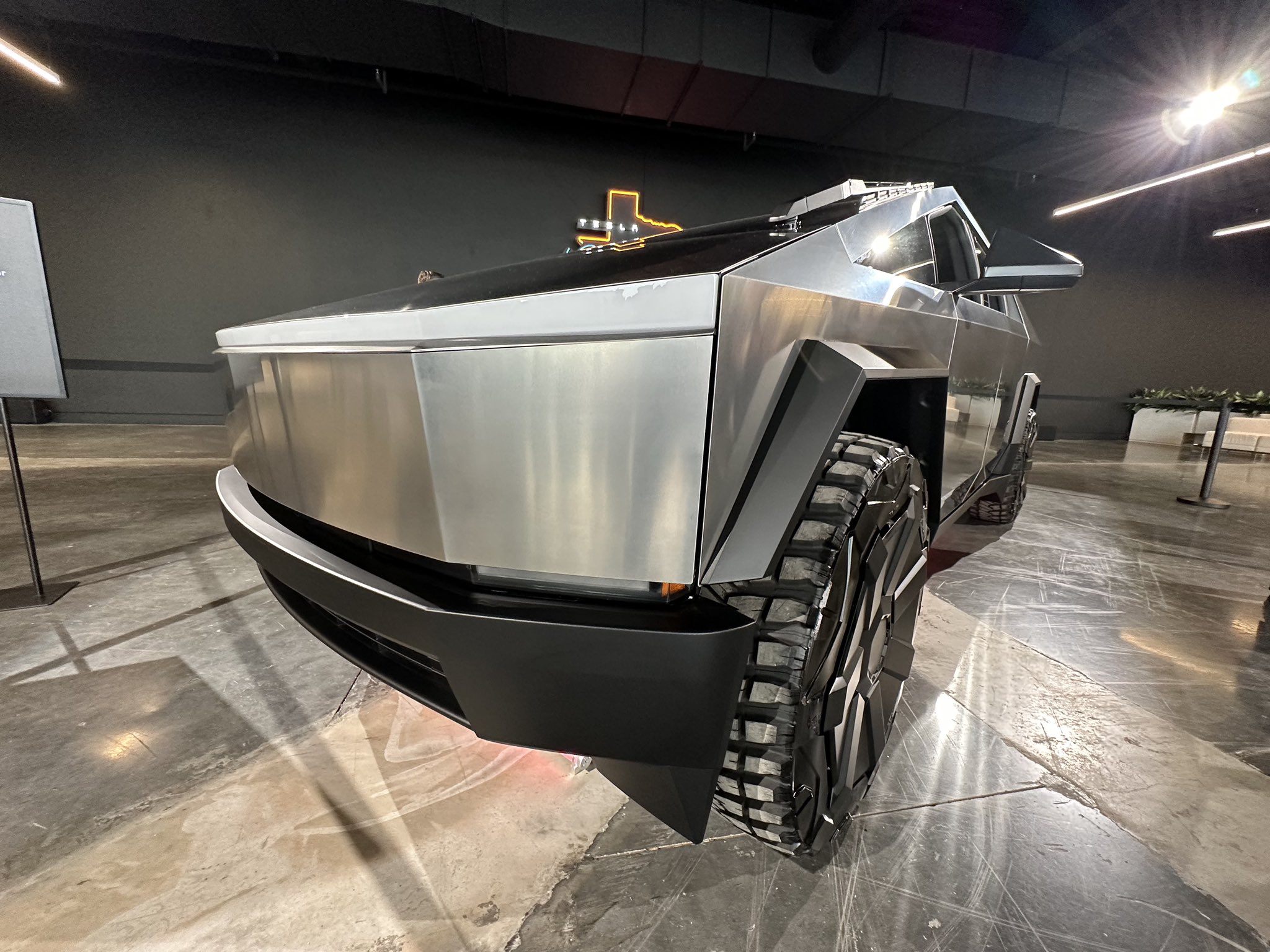
15:10 CST – The stream for Investor Day has not really started yet, but there are already some nice updates from attendees of the event. Take the Cybertruck production beta, for example. That beast looks pretty good. I’m not sure how to feel about the five-seat layout, though. I kinda miss the six seats in the original prototype.
15:07 CST – A close-up of that Investor Day graphic shows that the EV bodies may be Model Y crossovers, at least based on the shape at the rear. The event is now a few minutes late, which, in Tesla terms, is still pretty early.
15:05 CST – By the way, if you’re just joining us, welcome! Here’s a livestream of the event too.
15:02 CST – Tesla’s intro video for Investor features the graphic in the event’s invite. They were not kidding about this “scale” thing. It reminds me almost of “The Matrix.”
15:00 CST – Tesla’s livestream link for Investor Day is live! Here we go!
Don’t hesitate to contact us with news tips. Just send a message to simon@teslarati.com to give us a heads up.


News
SpaceX readies Starship Flight 14 for a historic journey into uncharted territory
SpaceX finished Starship’s Flight 14 rehearsal, clearing the way for its first orbital flight Monday.

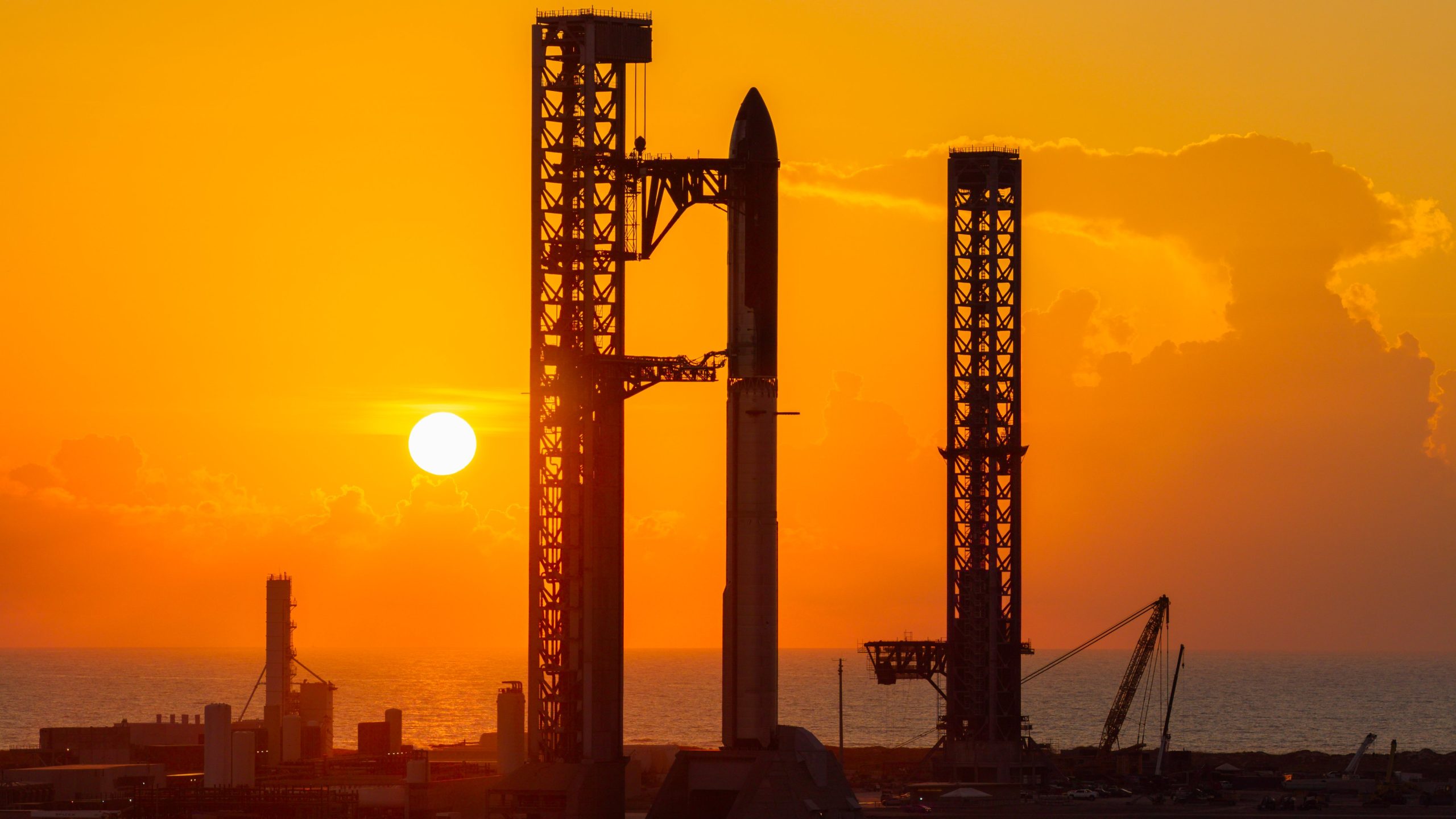
SpaceX has cleared one of the last hurdles before Starship’s first trip to orbit. The company posted on X Thursday afternoon that its launch rehearsal for Flight 14 was complete, keeping the mission on track for Monday, September 28. The launch window opens at 7:15 a.m. CT at Starbase, Texas, and runs for 75 minutes.
A wet dress rehearsal is essentially launch day without the launch. Crews fill Booster 21 and Ship 41 with thousands of tons of extremely cold propellant, run the countdown nearly to ignition, then drain everything back out. It lets engineers catch leaks or equipment problems before anything leaves the pad. SpaceX still needs a launch license from the FAA before the stack, which stands 407 feet tall, can fly.
Flight 14 matters because of where it is going. All 13 previous Starship flights followed a suborbital path, which works like throwing a ball extremely high and far: the vehicle reaches space, but it is always on a course that brings it back down within about an hour. This time, Ship 41 will perform a short engine firing called an orbital insertion burn roughly 25 minutes after liftoff, giving it enough speed to keep falling around Earth instead of back into it. SpaceX plans about six laps at an altitude near 275 kilometers (171 miles) over nearly 10 hours, as Teslarati detailed when the mission was first announced.
Launch rehearsal complete ahead of Starship Flight 14 pic.twitter.com/h5LBYyBqi4
— SpaceX (@SpaceX) September 24, 2026
Getting into orbit also means Starship has to prove it can get back out. The ship must relight a single Raptor engine in space to slow down for reentry. SpaceX says it will only attempt the orbital insertion burn after flight controllers confirm the hardware needed for that return burn has enough backup, and its flight plan includes health checks that could shorten the mission to two or five orbits.
Flight 14 is also the first to put working satellites into service. Flight 13 carried 20 Starlink V3 satellites in July, but they came back down with the ship because that mission never reached orbit. This time, 26 V3 satellites are meant to stay up and join the constellation within a few weeks. Together they add about 26 terabits per second of network capacity, which SpaceX says is roughly 10 times what a single Falcon 9 launch of older V2 Mini satellites adds. Three of them carry cameras that will photograph Starship’s heat shield in orbit to check for tile damage before reentry.
The hardware has changed too. Ship 41 flies with extra fasteners on tiles in the most vulnerable areas, fixes for gaps where superheated plasma slipped behind tiles, and curved tiles designed to reduce heating between them. Two tiles recovered from Ship 40 will fly again, the first reuse of any part of a Starship heat shield. Booster 21 carries better engine filtering and new relight software after ice clogged three center engines on the previous booster, leaving only eight of 13 engines to restart for its landing burn.
Ship 41 is targeting a splashdown in the Pacific Ocean west of Chile, a new recovery zone after several Indian Ocean landings, while Booster 21 aims for the Gulf. Neither will be caught by the tower on this flight. Elon Musk said in August that a ship catch was likely “in a few months.”
Elon Musk
Google just picked SpaceX for its first step into orbital AI
Google will launch its first Project Suncatcher AI satellite on SpaceX’s Transporter-18 rideshare next week.
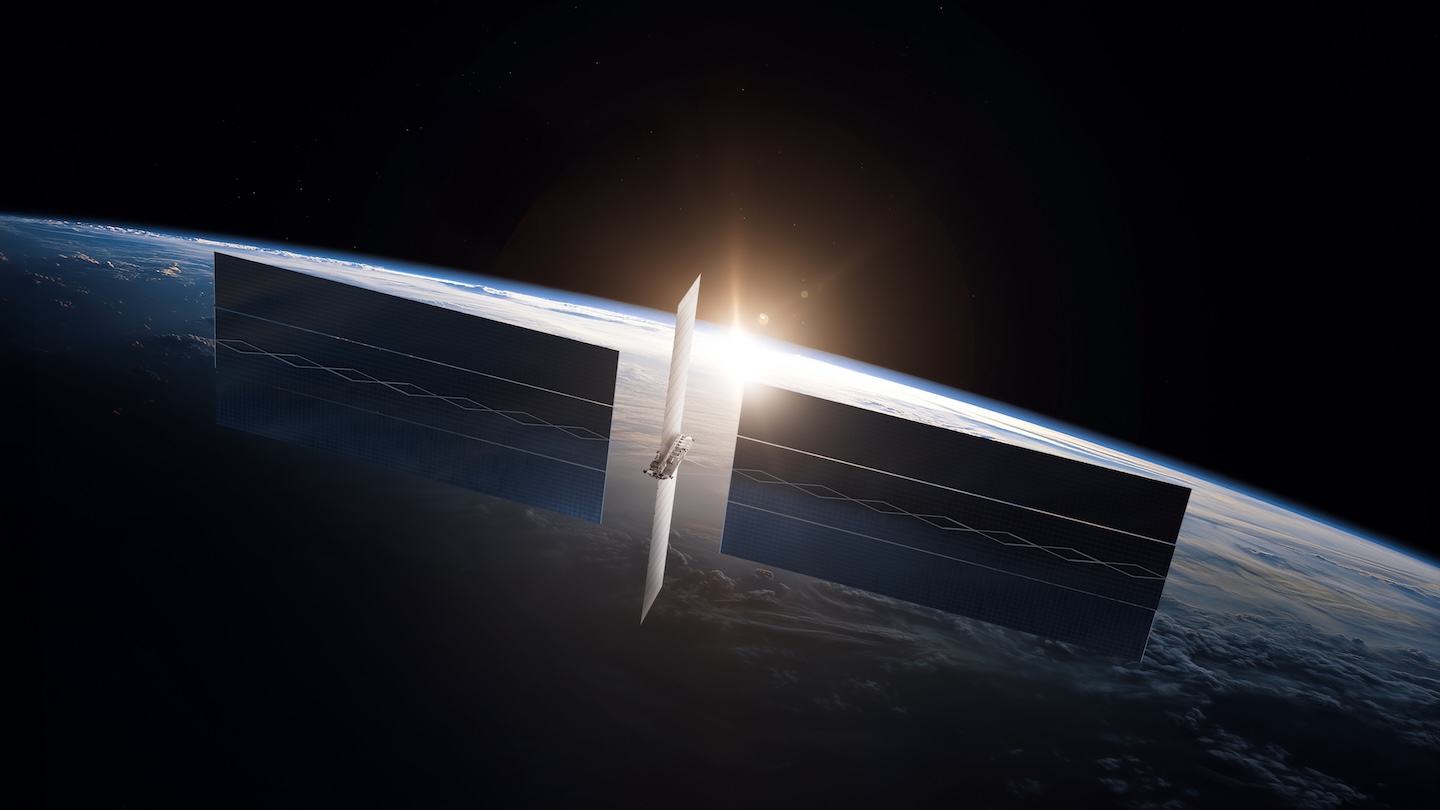
Google is about to put its own AI chips into orbit for the first time, and it is paying SpaceX to get them there.
The company said Thursday that the first in-orbit test of Project Suncatcher, its research effort to find out whether space can host large-scale AI computing, will fly next week on SpaceX’s Transporter-18 rideshare mission.
The satellite, called MVP, is about the size of a refrigerator and carries four of Google’s Tensor Processing Units, the same chips Google runs in its ground data centers. Google originally planned to launch two custom satellites in 2027, but chose to move faster by integrating its chips into a satellite.
MVP’s solar panels supply about one kilowatt of power, and Google will run Gemini models on the TPUs only in bursts of roughly 15 minutes before the chips shut down so the radiators can shed heat. In a blog post, Google said its Trillium TPUs survived vibration testing that mimicked sustained launch loads of up to 10g, with individual components seeing 50 to 100g, and handled a radiation dose greater than a five year mission would deliver.
SpaceX and Google mull massive partnership on Musk’s orbital data dream: report
Next week’s flight, slated for October 1, follows a relationship that became public in May, when Teslarati reported that Google was in talks with SpaceX for a launch deal tied to orbital data centers. Google also holds a stake of roughly 6% in SpaceX.
The two companies are chasing the same idea from very different starting points. SpaceX’s own orbital compute program is built around the AI1 satellite, a roughly 70 meter structure derived from Starlink V3 hardware that is designed for 150 kW of peak compute, about 150 times the power MVP will draw. Elon Musk has brushed off concerns about crowding orbit with those satellites, and SpaceX is building its Gigasat factory in Bastrop, Texas, to produce them, targeting an annualized rate of about 1 GW of space compute by the end of 2027.
Musk also posted on X on Thursday that “the amount of compute in space will obviously round up to 100% of all compute.”
Google has been more cautious in public. Its research estimates that launch prices need to fall below about $200 per kilogram before an orbital data center can compete with a ground facility on energy cost, a threshold the company believes could be reached around the mid 2030s. The Suncatcher team has said it expects the effort to remain a project rather than a product for years, which leaves the first real test of its hardware riding on a rocket from the company with the most aggressive timeline in the field.

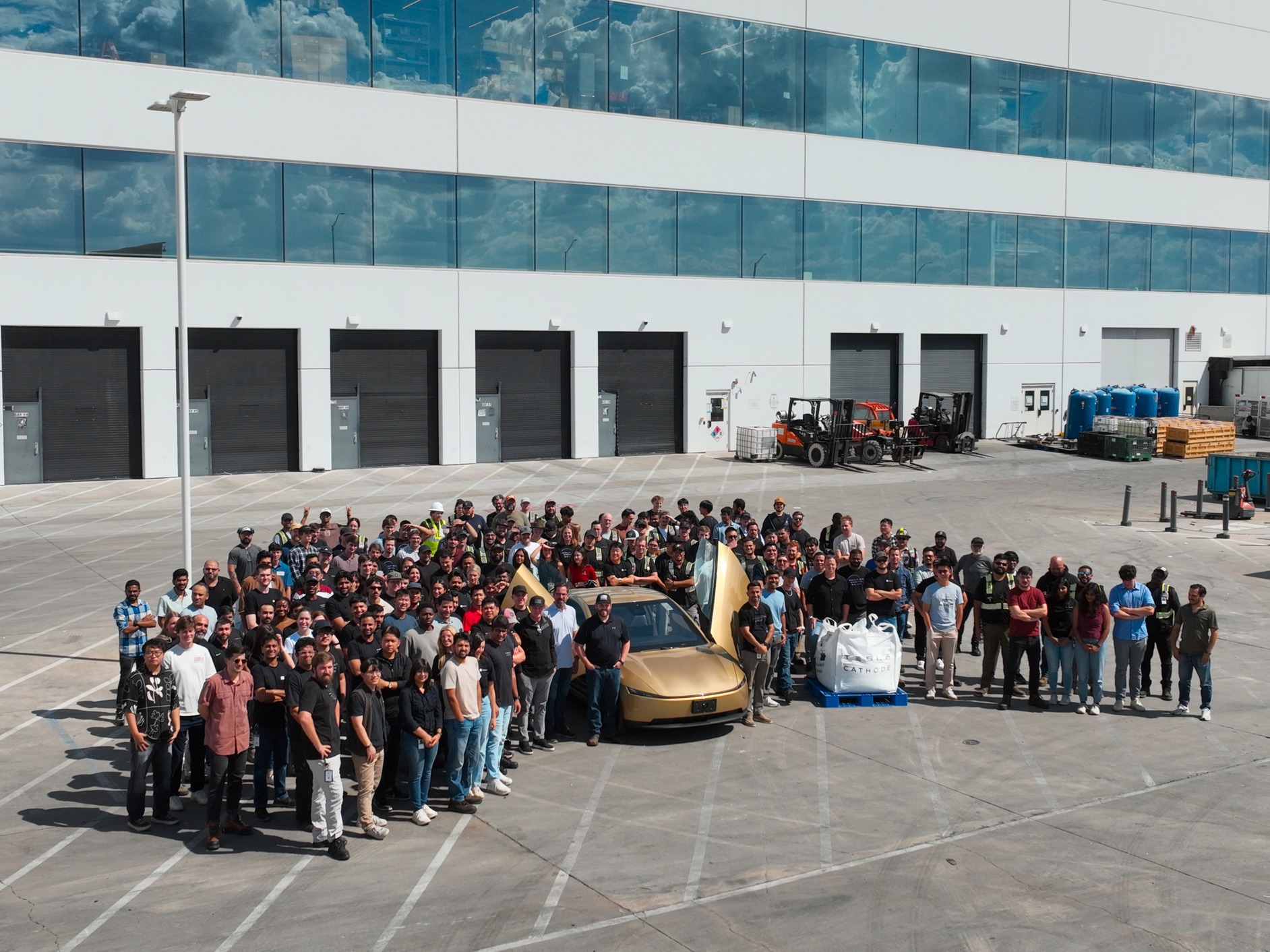
Tesla has taken another concrete step toward owning its battery supply chain, and it’s doing so with what is perhaps the most important vehicle in its short-but-storied history.
On September 23, Tesla announced that it has officially built the first Cybercab with cathode material produced in-house at the company’s first cathode plant in the U.S., and the first in the U.S. overall.
First Cybercab made using our in-house cathode material – from the first cathode plant in the Americas pic.twitter.com/X95aVXsT9H
— Robotaxi (@robotaxi) September 23, 2026
Active cathode material is the most expensive piece of a lithium-ion battery cell, and it often accounts for more than a third of cell cost. For years, the industry sourced a majority of it from Asia, but Tesla’s decision to make it in the United States bodes well for the Cybercab project. This is the latest chapter in Tesla’s vertical integration strategy, which began in public at Battery Day in 2020.
At the Battery Day Event, Elon Musk said the company would build a North American cathode plant and overhaul the process to cut costs and waste, while also making some of the most powerful and long-lasting cells in the industry.
The Austin facility took years to appear. Tesla filed permits for “Project Cathode” in 2022 on land near Giga Texas. By mid-2022, the building frame was up and Tesla later invested hundreds of millions of dollars as part of a larger expansion of the Giga Texas plant. The company stated it was operating the first large-scale cathode production facility in North America to supplement 4680 cell production.
One month later, that material reached a finished Cybercab.
Made with nickel cathode manufactured locally at Gigafactory Texas! https://t.co/DqMm5fZV3n
— Elon Musk (@elonmusk) September 24, 2026
The timing of this breakthrough is monumental for the Cybercab program. As Tesla officially launched the first Cybercab rides to the public earlier this month, production of the ride-hailing-geared vehicle is moving forward on the planned S-curve that CEO Elon Musk told everyone to expect.
Nevertheless, packs of Cybercab units have been spotted throughout the United States, in an effort to potentially activate the fleet as soon as the company gains regulatory approval in various geographic areas.
On top of that, Tesla owning the cathode step and pairing it with its own in-house lithium from the Gulf Coast refinery shortens the supply chain that once stretched thousands of miles and subjects every pack to fewer external price shocks and geopolitical risks.
Tesla is not yet independent of all of its foreign suppliers, as some precursor metals come from mines and chemical plants. But the first in-house cathode Cybercab shows the company is closing the most expensive and most concentrated gap in its battery production efforts. For a vehicle like Cybercab to operate at a high utilization within the Robotaxi network, that control over cost is so crucial.
It is arguably as important as the software that drives it.

SpaceX readies Starship Flight 14 for a historic journey into uncharted territory

Google just picked SpaceX for its first step into orbital AI


