News
Tesla patent aims to improve common on-road complaint

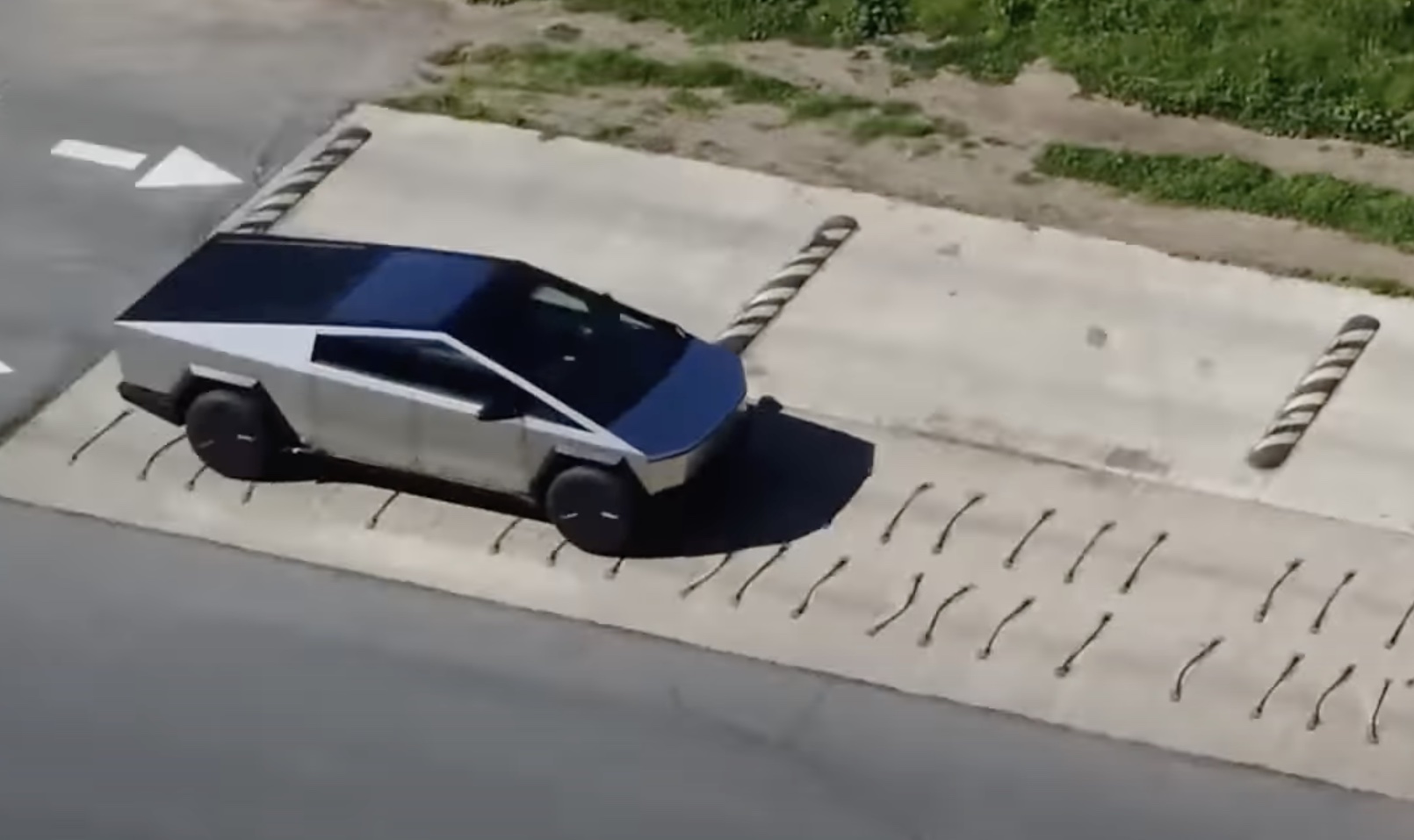
Tesla is continuing to push the boundaries of vehicle dynamics, as its latest published patent, US12654505B2, or “Suspension Actuator System for a Vehicle,’ which has finally been pushed through.
The design, which is credited to inventors Brian Lee Doorlag, Avraham Kagan, and Justin Sill, introduces a sophisticated hybrid suspension design that blends active motor-driven control with strategic passive elements to deliver superior ride quality, energy efficiency, and resilience against road imperfections, especially potholes.
Suspension Actuator System for a Vehicle@Tesla‘s US20240383297A1 patent introduces an innovative suspension actuator system that transforms vehicle suspension control through an intelligent combination of active and passive control elements.
By implementing both series and… https://t.co/vRvlOu3Dql pic.twitter.com/2WriXgpOvr
— SETI Park (@seti_park) November 27, 2024
At the heart of the system is an active control element powered by an electric motor. This motor drives a belt connected to a ball nut assembly and threaded screw, which adjusts the effective length of the suspension strut in real time.
By extending or retracting, the actuator can lift or lower the wheel more accurately, which can end up countering road disturbances. Sensors, including accelerometers and wheel position monitors, feed data to a suspension control system that processes inputs and commands the motor instantly.
This active component doesn’t work alone. A low-rate air spring mounts in parallel with the actuator. Its primary role is to offset much of the vehicle’s static weight, dramatically reducing the power demand on the motor.
Without this, the active system would constantly fight gravity, draining energy and generating heat. The air spring handles steady-state loads efficiently, allowing the motor to focus on dynamic adjustments.
Complementing this is a series of passive control elements—a spring and an adaptive damper—placed between the actuator and the wheel. This setup filters high-frequency vibrations before they reach the active motor, preventing it from overworking on minor inputs. The adaptive damper, potentially magnetorheological or valve-controlled, further tunes damping electronically for optimal comfort and stability.
How It Differs from Traditional Suspensions
Traditional passive suspensions compromise between comfort and handling, while pure active systems can be power-hungry and complex. Tesla’s hybrid approach resolves this by delegating tasks: the parallel air spring manages weight and low-frequency body motions, the series elements absorb rapid vibrations, and the active actuator tackles larger, lower-frequency events.
The result is a smoother, more isolated cabin experience. High-frequency road noise and harshness diminish, while the vehicle maintains precise control during cornering or acceleration. Energy efficiency improves, too—lower motor loads mean reduced battery drain, potentially extending range in electric vehicles.
How It Mitigates Potholes Specifically
Potholes are a major challenge because they provide a sudden drop to the wheel plunge, jarring the body of the vehicle, risking damage. The patent explicitly addresses this. Upon detecting a pothole (via sensors or predictive mapping), the control system activates
the motor to retract the strut, effectively pulling the wheel upward to minimize downward excursion. The series spring/damper cushions the impact, while the parallel air spring maintains overall support.
This proactive “wheel retraction” prevents sharp jolts, preserving passenger comfort and protecting components. Integrated with Tesla’s road roughness mapping patents, the system could anticipate potholes from fleet data, enabling preemptive adjustments for even smoother navigation.
Future Implications for Tesla Vehicles
This technology builds on Tesla’s existing adaptive dampers and air suspension that is seen in Cybertruck, but advances toward fully active control. It could roll out to future models, including refreshed Cybertrucks or next-gen vehicles, enhancing both daily drivability and off-road capability. By minimizing power use and complexity, it aligns with Tesla’s goals of efficiency and scalability.
In summary, US12654505B2 exemplifies Tesla’s engineering philosophy: intelligent integration over brute force. This hybrid suspension promises quieter, more comfortable rides and robust pothole defense, potentially setting a new standard for automotive comfort. As Tesla iterates, drivers can look forward to roads feeling far less rough.


News
SpaceX readies Starship Flight 14 for a historic journey into uncharted territory
SpaceX finished Starship’s Flight 14 rehearsal, clearing the way for its first orbital flight Monday.

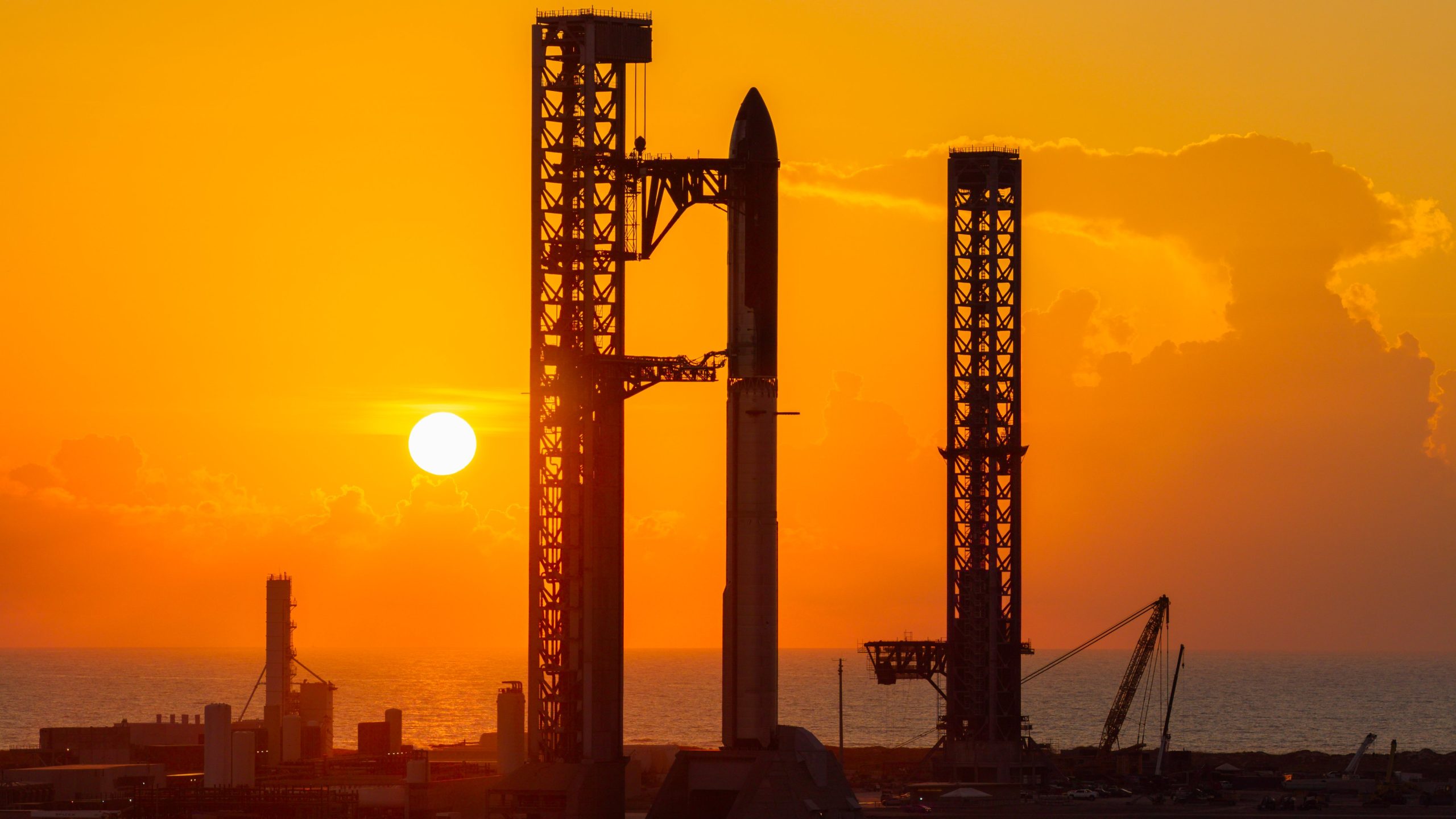
SpaceX has cleared one of the last hurdles before Starship’s first trip to orbit. The company posted on X Thursday afternoon that its launch rehearsal for Flight 14 was complete, keeping the mission on track for Monday, September 28. The launch window opens at 7:15 a.m. CT at Starbase, Texas, and runs for 75 minutes.
A wet dress rehearsal is essentially launch day without the launch. Crews fill Booster 21 and Ship 41 with thousands of tons of extremely cold propellant, run the countdown nearly to ignition, then drain everything back out. It lets engineers catch leaks or equipment problems before anything leaves the pad. SpaceX still needs a launch license from the FAA before the stack, which stands 407 feet tall, can fly.
Flight 14 matters because of where it is going. All 13 previous Starship flights followed a suborbital path, which works like throwing a ball extremely high and far: the vehicle reaches space, but it is always on a course that brings it back down within about an hour. This time, Ship 41 will perform a short engine firing called an orbital insertion burn roughly 25 minutes after liftoff, giving it enough speed to keep falling around Earth instead of back into it. SpaceX plans about six laps at an altitude near 275 kilometers (171 miles) over nearly 10 hours, as Teslarati detailed when the mission was first announced.
Launch rehearsal complete ahead of Starship Flight 14 pic.twitter.com/h5LBYyBqi4
— SpaceX (@SpaceX) September 24, 2026
Getting into orbit also means Starship has to prove it can get back out. The ship must relight a single Raptor engine in space to slow down for reentry. SpaceX says it will only attempt the orbital insertion burn after flight controllers confirm the hardware needed for that return burn has enough backup, and its flight plan includes health checks that could shorten the mission to two or five orbits.
Flight 14 is also the first to put working satellites into service. Flight 13 carried 20 Starlink V3 satellites in July, but they came back down with the ship because that mission never reached orbit. This time, 26 V3 satellites are meant to stay up and join the constellation within a few weeks. Together they add about 26 terabits per second of network capacity, which SpaceX says is roughly 10 times what a single Falcon 9 launch of older V2 Mini satellites adds. Three of them carry cameras that will photograph Starship’s heat shield in orbit to check for tile damage before reentry.
The hardware has changed too. Ship 41 flies with extra fasteners on tiles in the most vulnerable areas, fixes for gaps where superheated plasma slipped behind tiles, and curved tiles designed to reduce heating between them. Two tiles recovered from Ship 40 will fly again, the first reuse of any part of a Starship heat shield. Booster 21 carries better engine filtering and new relight software after ice clogged three center engines on the previous booster, leaving only eight of 13 engines to restart for its landing burn.
Ship 41 is targeting a splashdown in the Pacific Ocean west of Chile, a new recovery zone after several Indian Ocean landings, while Booster 21 aims for the Gulf. Neither will be caught by the tower on this flight. Elon Musk said in August that a ship catch was likely “in a few months.”
Elon Musk
Google just picked SpaceX for its first step into orbital AI
Google will launch its first Project Suncatcher AI satellite on SpaceX’s Transporter-18 rideshare next week.
Google is about to put its own AI chips into orbit for the first time, and it is paying SpaceX to get them there.
The company said Thursday that the first in-orbit test of Project Suncatcher, its research effort to find out whether space can host large-scale AI computing, will fly next week on SpaceX’s Transporter-18 rideshare mission.
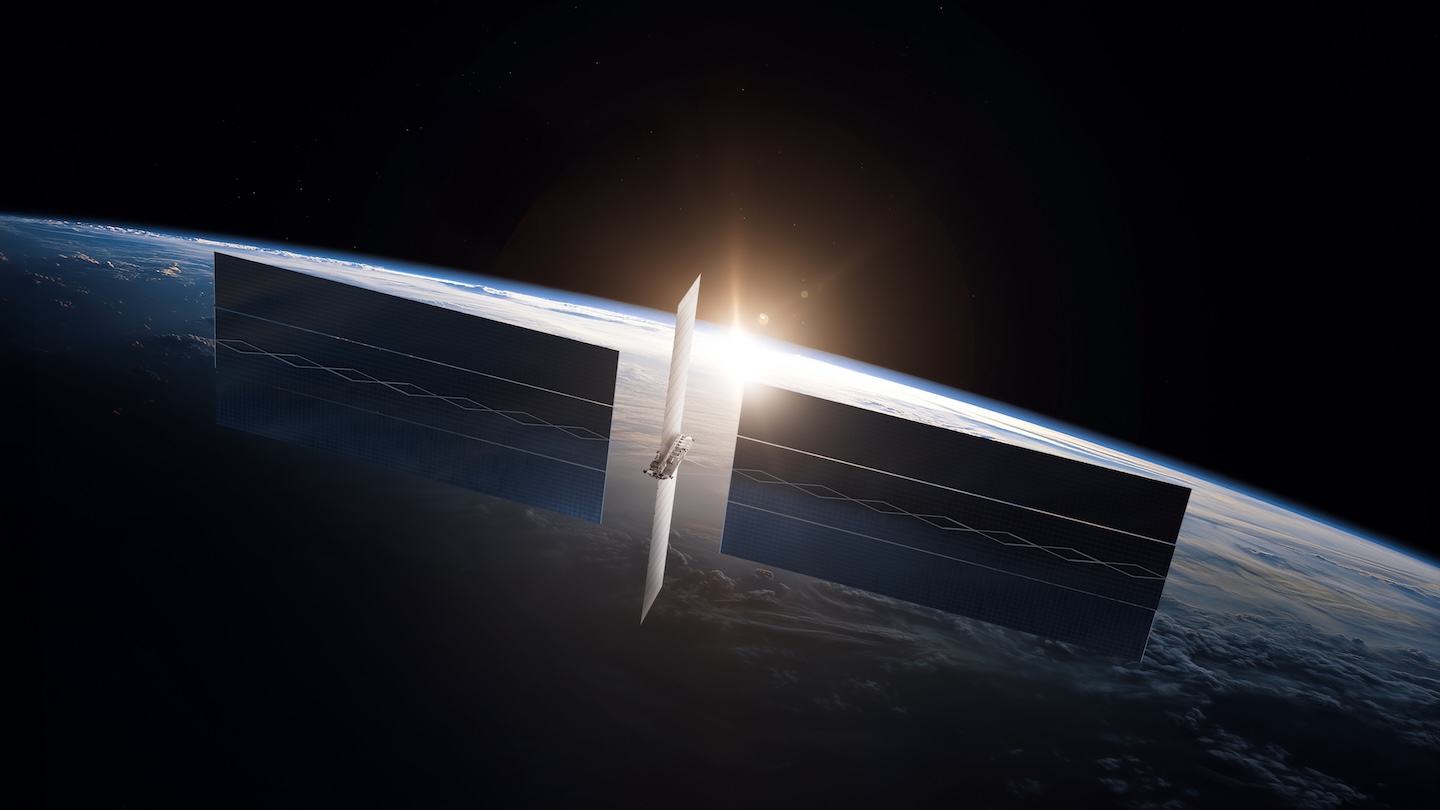
The satellite, called MVP, is about the size of a refrigerator and carries four of Google’s Tensor Processing Units, the same chips Google runs in its ground data centers. Google originally planned to launch two custom satellites in 2027, but chose to move faster by integrating its chips into a satellite.
MVP’s solar panels supply about one kilowatt of power, and Google will run Gemini models on the TPUs only in bursts of roughly 15 minutes before the chips shut down so the radiators can shed heat. In a blog post, Google said its Trillium TPUs survived vibration testing that mimicked sustained launch loads of up to 10g, with individual components seeing 50 to 100g, and handled a radiation dose greater than a five year mission would deliver.
SpaceX and Google mull massive partnership on Musk’s orbital data dream: report
Next week’s flight, slated for October 1, follows a relationship that became public in May, when Teslarati reported that Google was in talks with SpaceX for a launch deal tied to orbital data centers. Google also holds a stake of roughly 6% in SpaceX.
The two companies are chasing the same idea from very different starting points. SpaceX’s own orbital compute program is built around the AI1 satellite, a roughly 70 meter structure derived from Starlink V3 hardware that is designed for 150 kW of peak compute, about 150 times the power MVP will draw. Elon Musk has brushed off concerns about crowding orbit with those satellites, and SpaceX is building its Gigasat factory in Bastrop, Texas, to produce them, targeting an annualized rate of about 1 GW of space compute by the end of 2027.
Musk also posted on X on Thursday that “the amount of compute in space will obviously round up to 100% of all compute.”
Google has been more cautious in public. Its research estimates that launch prices need to fall below about $200 per kilogram before an orbital data center can compete with a ground facility on energy cost, a threshold the company believes could be reached around the mid 2030s. The Suncatcher team has said it expects the effort to remain a project rather than a product for years, which leaves the first real test of its hardware riding on a rocket from the company with the most aggressive timeline in the field.
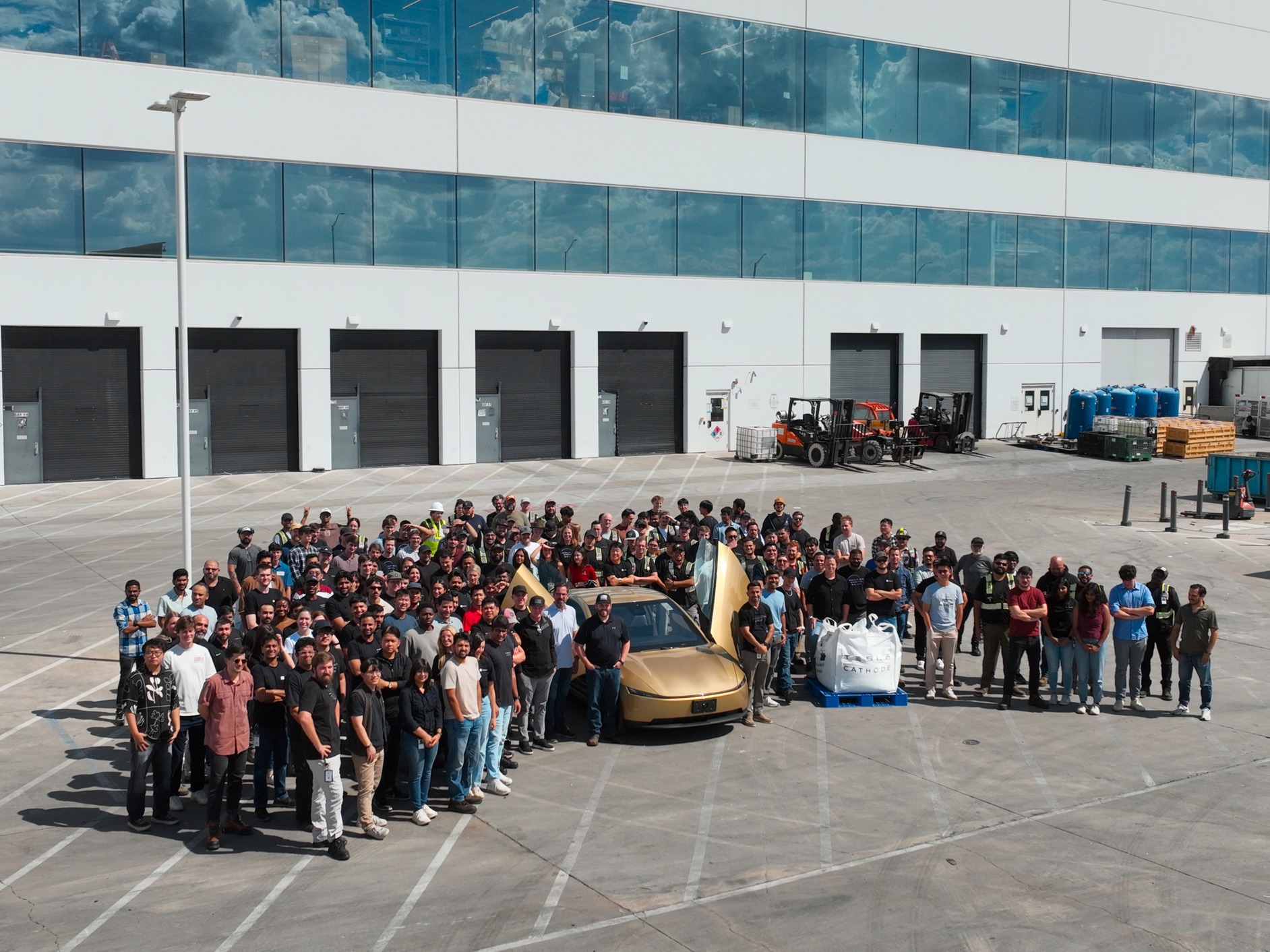
Tesla has taken another concrete step toward owning its battery supply chain, and it’s doing so with what is perhaps the most important vehicle in its short-but-storied history.
On September 23, Tesla announced that it has officially built the first Cybercab with cathode material produced in-house at the company’s first cathode plant in the U.S., and the first in the U.S. overall.
First Cybercab made using our in-house cathode material – from the first cathode plant in the Americas pic.twitter.com/X95aVXsT9H
— Robotaxi (@robotaxi) September 23, 2026
Active cathode material is the most expensive piece of a lithium-ion battery cell, and it often accounts for more than a third of cell cost. For years, the industry sourced a majority of it from Asia, but Tesla’s decision to make it in the United States bodes well for the Cybercab project. This is the latest chapter in Tesla’s vertical integration strategy, which began in public at Battery Day in 2020.
At the Battery Day Event, Elon Musk said the company would build a North American cathode plant and overhaul the process to cut costs and waste, while also making some of the most powerful and long-lasting cells in the industry.
The Austin facility took years to appear. Tesla filed permits for “Project Cathode” in 2022 on land near Giga Texas. By mid-2022, the building frame was up and Tesla later invested hundreds of millions of dollars as part of a larger expansion of the Giga Texas plant. The company stated it was operating the first large-scale cathode production facility in North America to supplement 4680 cell production.
One month later, that material reached a finished Cybercab.
Made with nickel cathode manufactured locally at Gigafactory Texas! https://t.co/DqMm5fZV3n
— Elon Musk (@elonmusk) September 24, 2026
The timing of this breakthrough is monumental for the Cybercab program. As Tesla officially launched the first Cybercab rides to the public earlier this month, production of the ride-hailing-geared vehicle is moving forward on the planned S-curve that CEO Elon Musk told everyone to expect.
Nevertheless, packs of Cybercab units have been spotted throughout the United States, in an effort to potentially activate the fleet as soon as the company gains regulatory approval in various geographic areas.
On top of that, Tesla owning the cathode step and pairing it with its own in-house lithium from the Gulf Coast refinery shortens the supply chain that once stretched thousands of miles and subjects every pack to fewer external price shocks and geopolitical risks.
Tesla is not yet independent of all of its foreign suppliers, as some precursor metals come from mines and chemical plants. But the first in-house cathode Cybercab shows the company is closing the most expensive and most concentrated gap in its battery production efforts. For a vehicle like Cybercab to operate at a high utilization within the Robotaxi network, that control over cost is so crucial.
It is arguably as important as the software that drives it.

SpaceX readies Starship Flight 14 for a historic journey into uncharted territory

Google just picked SpaceX for its first step into orbital AI


